

Table of contents
- Automatic vs semi-automatic vs manual: Quick comparison
- What matters most when choosing a motorbike?
- Can you ride the Cao Bang Loop on an automatic scooter?
- Is a semi-automatic the best all-round choice?
- Who should choose a manual motorbike?
- Is 110cc enough for the Cao Bang Loop?
- What is the best motorbike for two riders and luggage?
- How we help you choose the right motorbike?
- What equipment comes with the rental?
- Choose the bike that fits you
Quick answer: If you already know how to use foot gears, a semi-automatic is usually the easiest all-round choice. Confident scooter riders can use an automatic on the standard paved route. A manual is best to riders who regularly use a hand clutch.
In this guide:
- The standard paved route means the main paved roads connecting Cao Bang City with the principal stops on the loop, without optional rough shortcuts or small mountain tracks.
- Compact luggage means one small travel bag secured to the bike without taking up the passenger seat or restricting the rider’s movement.
Automatic vs semi-automatic vs manual: Quick comparison
| Motorbike type | Best for | Main advantage | Think twice if |
|---|---|---|---|
| Automatic | Riders already comfortable on scooters and mainly using paved roads | Simple controls and useful under-seat storage | You are carrying a heavy load or planning rougher roads |
| Semi-automatic | Riders familiar with foot gears who want a light, practical bike | Direct gear selection without a hand clutch | You have never used foot gears |
| Manual | Experienced riders comfortable with a hand clutch and larger motorcycles | Direct control of the clutch and gears | The bike feels tall, heavy or awkward at low speed |
Use this as a quick guide, not a fixed rule. Your experience, height, passenger, luggage and route all matter.
About our motorbike fleet
Cao Bang Eco Travel offers up to 10 models across automatic, semi-automatic and manual categories. We do not keep a rental motorbike in service for more than two years. Rather than assigning everyone the same model, we look at your riding experience, passenger, luggage and planned route before making a recommendation.
What matters most when choosing a motorbike?
Before comparing individual models, start with four practical questions.
What type of bike do you already ride?
Choose controls that already feel familiar.
If you normally ride a scooter, an automatic will probably feel most natural. If you are used to foot gears, a semi-automatic may give you better control without adding a hand clutch. A manual only makes sense when clutch control, hill starts and slow turns already feel routine.
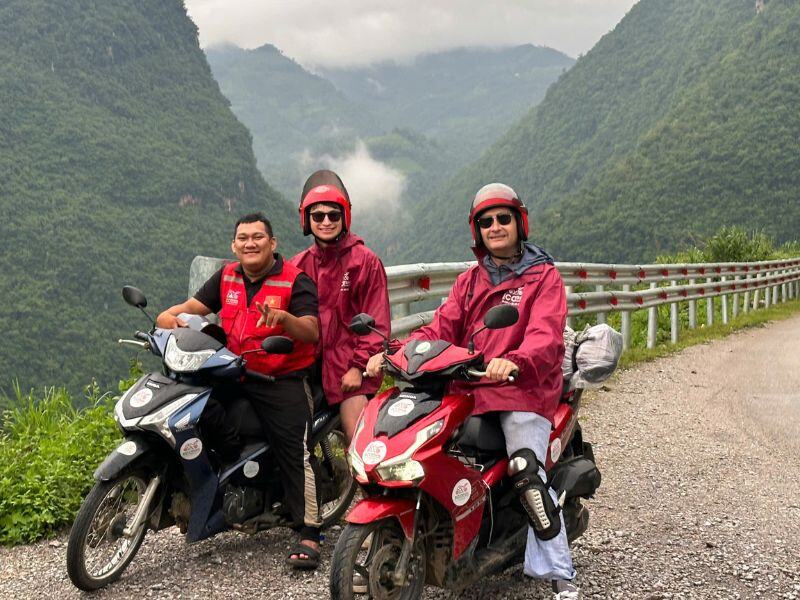
The Cao Bang Loop is not a good place to learn a completely new type of motorbike.
If you have little or no riding experience, an easy rider is the more sensible choice. You can still follow the same route as friends who rent and ride their own bikes.
Are you riding alone or with a passenger?
A bike that feels light and easy with one rider can behave very differently once a second person and luggage are added.
The extra load affects:
- Acceleration
- Braking distance
- Balance at low speed
- Passenger space
- Suspension comfort
Think about the whole setup, not just the engine size.
Which roads are you planning to use?
The main Cao Bang Loop is largely paved, but road conditions are not identical everywhere.
A bike chosen for the standard route does not need the same setup as one used on damaged roads, rough shortcuts or smaller mountain tracks.
Ask us about the route before choosing a model. Heavy rain, landslides and roadworks can change which roads are practical, so we base our recommendation on current conditions as well as your planned itinerary.
Can you manage the bike at low speed?
A bike should feel manageable when you are:
- Stopping on a slope
- Parking
- Turning around
- Moving slowly through town
- Holding the bike with luggage attached
A larger motorcycle is not useful if you struggle to keep it steady.
The condition of the actual bike matters too. A smaller, well-maintained bike is a better choice than a larger one with worn tires or weak brakes.
Review the full Cao Bang Loop preparation checklist before departure.
Can you ride the Cao Bang Loop on an automatic scooter?
Yes. An automatic scooter can handle the Cao Bang Loop when the rider already feels confident on scooters and plans to stay mainly on the standard paved route.
The controls are simple because there are no foot gears or hand clutch. This lets you focus more on traffic, bends and the road ahead.
Simple controls do not make mountain riding effortless, however. You still need good braking, balance and speed control.
When an automatic works well
An automatic is a practical choice for:
- Riders who regularly use scooters
- Solo travelers with compact luggage
- Two people traveling with limited luggage
- Travelers staying mainly on paved roads
- Riders comfortable using both brakes on long descents
Automatic scooters also provide some under-seat storage, although the available space differs by model. Larger bags still need to be secured separately.
When an automatic may not be the best choice
Think carefully before choosing an automatic when:
- You are carrying a passenger and substantial luggage
- Your route includes rough shortcuts or badly damaged roads
- You are not comfortable controlling speed on long descents
- The loaded scooter feels unstable during stops or slow turns
An automatic still provides some engine braking, but you cannot deliberately choose a lower gear as directly as you can on a semi-automatic or manual bike.
Vision 110, Air Blade 125 or Air Blade 160?
| Model | Best for | What to consider |
|---|---|---|
| Honda Vision 110 | Solo riders or two people traveling with limited luggage | Comfortable for two on the standard paved route when the combined load is suitable |
| Honda Air Blade 125 | Confident scooter riders, including couples carrying luggage | Can carry up to two small suitcases on the rear rack after their size, weight and position have been checked |
| Honda Air Blade 160 | Experienced scooter riders wanting more power for hills, passengers or luggage | More power is useful under load, but the fully loaded scooter must still feel easy to control |
A Vision 110 works well for many couples traveling lightly. Once you add a passenger and two small suitcases, an Air Blade usually gives you a more comfortable power margin.
Is a semi-automatic the best all-round choice?
For many riders, yes.
A semi-automatic lets you gears directly without using a hand clutch. It is also generally light enough to manage easily during stops, parking and U-turns.
This makes it a good middle ground, but only when foot gears are already familiar.
When a semi-automatic works well
A semi-automatic is a strong choice for:
- Riders familiar with a Honda Wave, Blade, Future or similar bike
- Solo travelers with compact luggage
- Riders who want to gears without using a hand clutch
- Travelers who prefer a lighter bike at low speed
- Riders following the standard paved route
Being able to choose a lower gear is helpful on long climbs and descents.
When a semi-automatic may not suit you
Choose another type of bike when:
- You have never used foot gears
- Gear changes still require too much concentration
- Under-seat storage is important to you
- The selected model does not suit your passenger and luggage
Do not plan to learn foot gears during the first day of the loop. Practise beforehand and test the actual bike before leaving Cao Bang City.
For practical instructions, read our semi-automatic riding guide.
Wave 110, Future 125 or Yamaha PG-1?
| Model | Best for | What to consider |
|---|---|---|
| Honda Wave 110 | Solo riders with compact luggage | Light and simple, but has less power in reserve when more weight is added |
| Honda Future 125 | Solo riders or two people carrying luggage | Can carry up to two small suitcases on the rear rack after the load and luggage dimensions have been checked |
| Yamaha PG-1 115 | Solo riders carrying more luggage | Can also carry a passenger when little or no additional luggage is added |
A semi-automatic may be the best all-round category, but the right model still depends on how many people and bags it needs to carry.
Who should choose a manual motorbike?
A manual is for riders who already use a hand clutch confidently.
It gives an experienced rider direct control over the clutch and gears, but it also adds more work at low speed. Many manual models are taller and heavier than the automatic and semi-automatic options.
Do not choose one simply because it has more power or looks better suited to mountain roads.
When a manual works well
A manual can be a good fit if you:
- Regularly ride with a hand clutch
- Are comfortable starting and stopping on slopes
- Can control the clutch smoothly at low speed
- Have experience with taller dual-sport or supermoto motorcycles
- Can hold and move the bike confidently with luggage attached
A manual is only a practical choice when the actual bike feels familiar and manageable.
When a manual is the wrong choice
Avoid choosing a manual when:
- You have little or no hand-clutch experience
- You struggle to balance a tall motorcycle
- Hill starts and slow turns are not yet natural
- You want a light bike for frequent stops
- You expect extra power to make up for limited experience
Before leaving, you should be able to stop, turn, park and hold the loaded bike without struggling.
Winner X, XR150L, XR190L or KLX230SM?
| Model | Best for | What to consider |
|---|---|---|
| Honda Winner X 150 | Confident manual riders mainly using paved roads | Uses a standard rear rack; luggage must be positioned and secured properly |
| Honda XR150L | Riders already familiar with taller dual-sport motorcycles | Uses a standard rear rack; its height and loaded balance will not suit everyone |
| Honda XR190L | Experienced riders wanting a larger manual bike for luggage, a passenger or longer routes | The rider needs to remain comfortable with its size and weight at low speed |
| Kawasaki KLX230SM | Experienced riders wanting a tall, road-focused supermoto | Its height and riding position require previous experience with larger manual motorcycles |
Winner X, XR150L, XR190L and Kawasaki KLX230SM belong to our larger manual-bike category. The controls, seat height and weight should already feel comfortable before you take one onto the loop.
Already know which type suits you?
Compare the automatic, semi-automatic and manual bikes in our current fleet.
Is 110cc enough for the Cao Bang Loop?
Yes. Although 110cc may sound small for a mountain journey, a well-maintained bike is still enough for many riders following the standard paved route with a manageable load.
Honda Wave 110 and Yamaha PG-1 115 are familiar sights on the mountain roads of Cao Bang. Local riders often choose these models because their engines run steadily, the bikes are easy to control, and they can be fitted with different types of rear racks for carrying goods. When the correct gear is used, they can handle ordinary mountain climbs well despite their relatively small engines.
A 110cc or 115cc bike may climb more slowly than a 125cc or 150cc model on long hills, but slower does not mean unsuitable. On mountain roads, bike control, appropriate gear selection and stable load positioning often matter more than engine size alone.
The main consideration is the combined weight of the people on the bike. If the rider and passenger weigh more than around 120 kg in total, whether that means one person or two, a 110cc bike may begin to lose power more noticeably on long climbs. Additional luggage increases the load further, so we usually recommend moving up to a 125cc or larger bike in this situation.
You should also consider a larger engine when:
- The combined weight of the rider and passenger is more than around 120 kg
- You are carrying heavy or bulky luggage
- You will regularly carry two people on long uphill sections
- You want more power and acceleration when the bike is fully loaded
For one or two people whose combined weight remains suitable, along with compact luggage, a Honda Wave 110 can still handle the standard Cao Bang Loop well. The Yamaha PG-1 115 is particularly useful for a solo rider carrying more luggage because it allows flexible rear-rack configurations.
When the total load is higher, a Future 125, Air Blade or a manual bike suited to the rider’s experience will usually be the more practical choice.
What is the best motorbike for two riders and luggage?
For two people, the best bike is not simply the one with the largest engine.
You also need enough seat space, a suitable rear rack and a luggage setup that does not make the bike difficult to balance.
Two riders with limited luggage
A Honda Vision 110 can comfortably carry two people on the standard paved route when luggage is limited and the combined load remains suitable.
Two riders with two small suitcases
A Honda Future 125 or Air Blade can carry two people with up to two small suitcases secured to the rear rack.
This means genuinely compact cases, not two large checked suitcases. Before departure, we check:
- The size of each case
- Their combined weight
- How they sit on the rack
- Whether the passenger still has enough space
- Whether the rider can control the loaded bike comfortably
The fact that two bags physically fit does not mean the setup is suitable.
Solo rider with more luggage
A Yamaha PG-1 is a useful option for a solo rider who needs to carry more luggage.
It can also take a passenger when little or no extra luggage is added.
Experienced manual rider with a passenger
Winner X, XR150L and XR190L can be considered when the rider already feels comfortable with a hand clutch and can control the bike with the full load attached.
These models use a standard rear rack.
Two riders with large or heavy luggage
Do not force oversized luggage onto one bike.
A better option is to:
- Store unnecessary suitcases in Cao Bang City
- Repack smaller bags
- Use two motorbikes
- Ask us to assess the setup before confirming the bike
How should luggage be secured?
A practical setup keeps:
- Luggage firmly attached to the rear rack
- Weight distributed evenly
- Heavier items low and close to the center of the bike
- The passenger seat clear
- The rider’s movement unrestricted
We recommend testing the bike with the actual passenger and luggage before leaving Cao Bang City.
If it feels difficult to start, stop or turn in town, it will not become easier in the mountains.
How we help you choose the right motorbike?
Before we recommend a bike, we first ask a few practical questions:
- What type of motorbike you normally ride
- Your experience with foot gears or a hand clutch
- Your height
- Whether you have a passenger
- The amount and size of your luggage
- The route you plan to follow
We then match that information with the bikes currently available and help you test the complete setup before departure.
A few common starting points are:
- Solo scooter rider: Vision 110 or Air Blade
- Two people with limited luggage: Vision 110
- Two people with up to two small suitcases: Future 125 or Air Blade
- Solo rider familiar with foot gears: Wave 110, Future 125 or PG-1
- Solo rider carrying more luggage: PG-1 or Future
- Two people with little or no additional luggage: PG-1 can be considered
- Experienced manual rider: Winner X, XR150L, XR190L or KLX230SM
- First-time rider: Choose an easy rider instead of learning on the loop
Not everyone in a group has to make the same choice. Confident riders can rent their own bikes while another traveler joins an easy rider and follows the same route.
These are practical starting points, not fixed assignments. The final choice still depends on the bikes available, the planned route and how the complete setup feels during the test ride.
What equipment comes with the rental?
Standard automatic and semi-automatic rentals include:
- A helmet
- Luggage straps
- A rain poncho
Rentals of Winner X, XR150L, XR190L and Kawasaki KLX230SM include the following equipment at no extra charge:
- A full-face helmet with an action-camera mount
- Protective gloves
- Elbow guards
- Knee and shin guards
The action camera itself is not included.
Protective body armour is available for an additional rental fee.
Let us know before arrival so we can prepare the correct equipment and sizes.
Protective gear does not replace riding experience or the appropriate licence for the motorbike you choose.
See current models, rental rates and available equipment.
Choose the bike that fits you
The best motorbike for the Cao Bang Loop is not necessarily the fastest, largest or most expensive one.
Choose a bike whose controls you already know, whose height and weight you can manage, and whose passenger and luggage setup feels stable.
Find the right motorbike for your Cao Bang Loop
Browse our current fleet and rental rates, or tell us about your riding experience, passenger and luggage. We will help you narrow down the most practical options before you arrive.

Have 0 comments, reviews about Best Motorbike for the Cao Bang Loop: Automatic, Semi or Manual?
Hello. Please leave a comment, we will respond soon.