

Table of contents
- Author’s TL;DR
- Is Khuoi Ky Stone Village worth visiting?
- Why is Khuoi Ky known as a stone village?
- What can you do during a short visit?
- What is it really like to stay overnight?
- What food should you expect at a homestay?
- How should Khuoi Ky fit into a Ban Gioc itinerary?
- How do you get to Khuoi Ky Stone Village?
- When is the best time to visit?
- How can you visit respectfully and safely?
- Practical questions not to overlook
- Final advice
Author’s TL;DR
Khuoi Ky Stone Village is a small Tay village in Dam Thuy Commune, Cao Bang Province, about 2 km from Ban Gioc Waterfall. Most travelers need 45 to 90 minutes to walk through its stone lanes and see the old stilt houses. Staying overnight offers a closer look at village life, but comfort varies: an original stone house may have shared sleeping areas and shared bathrooms, while newer homestays offer private rooms and more modern facilities.
I would not recommend making the journey from Hanoi for Khuoi Ky alone. But if Ban Gioc Waterfall and Nguom Ngao Cave are already on your route, the village adds a cultural stop that is easy to fit in. Its small scale is part of the appeal.
Essential information
|
Details
|
|---|---|
Current location
|
Dam Thuy Commune, Cao Bang Province (formerly part of Trung Khanh District)
|
Distance from Ban Gioc
|
About 2 km
|
Best combined with
|
Ban Gioc Waterfall and Nguom Ngao Cave
|
Suggested visit
|
45 to 90 minutes, or one night for a homestay experience
|
Known for
|
Tay stone stilt houses, stone lanes, local homestays and village life
|
Accommodation
|
Original stone houses with simple shared facilities, plus newer stone-inspired homestays with more comfort
|
Best for
|
Culture, architecture, photography, local food and slow travel
|
Is Khuoi Ky Stone Village worth visiting?
Yes, if Ban Gioc Waterfall or Nguom Ngao Cave is already part of your route. In my view, Khuoi Ky adds something those two places cannot: a look at how Tay families still live around old stone houses. Its value is not one grand monument, but the details: stone walls darkened by age, wooden floors, tiled roofs, family courtyards and daily routines continuing around visitors.
A short stop is enough for travelers who mainly want to see the architecture. Stay longer if you enjoy photography, local food or conversations with a host family. An overnight stay is most rewarding for travelers who accept simple facilities in exchange for a more direct experience of village life.
Khuoi Ky may be less suitable if you have very limited time, need hotel-level comfort or are looking only for dramatic landscapes. It is also not worth making a same-day return trip from Hanoi solely for the village.
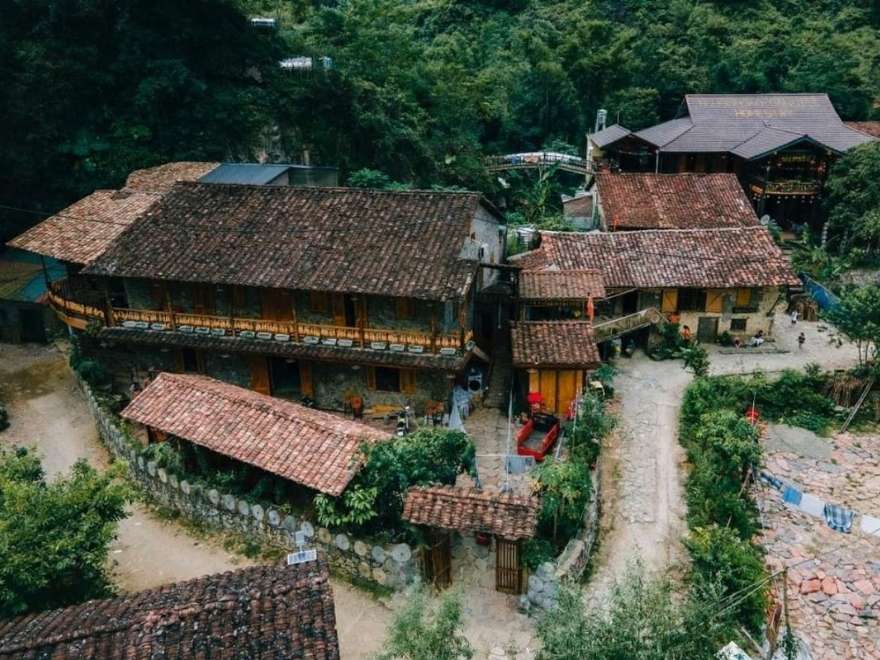
Khuoi Ky is a living Tay village about 2 km from Ban Gioc Waterfall.
Why is Khuoi Ky known as a stone village?
Khuoi Ky is associated with the period between 1594 and 1677, when the Mac dynasty established a stronghold in Cao Bang after losing control of Thang Long. The village later became known for an unusual form of Tay architecture in which stone was used not only for foundations, but also for walls, steps, fences, courtyards, mills and small water structures.
The village covers roughly 10,000 square meters. Sources do not always count its homes in the same way, but the figures most often cited are around 14 traditional stone stilt houses and about 16 Tay households. These numbers vary by source and should be treated as approximate.
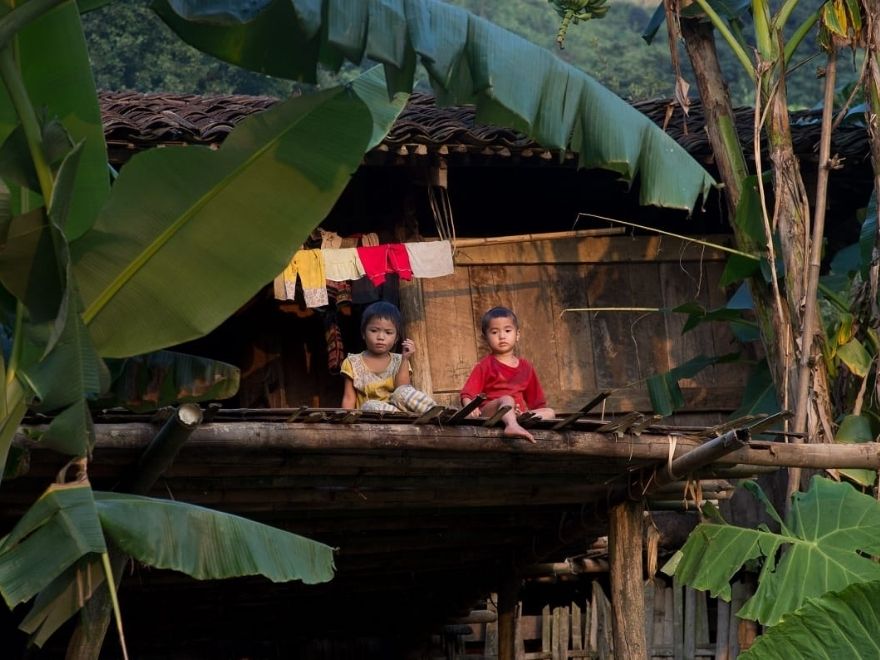
Traditional houses form a compact village at the foot of Cao Bang's limestone mountains.
The houses usually have two levels and are commonly reported to stand around 5 to 7 meters high. Thick stone walls support wooden frames and upper living areas, while traditional yin-yang tiles cover the roofs. In the traditional three-part layout, the upper floor has a central room for receiving guests and the family altar, sleeping rooms to one side, and the kitchen and working space to the other.
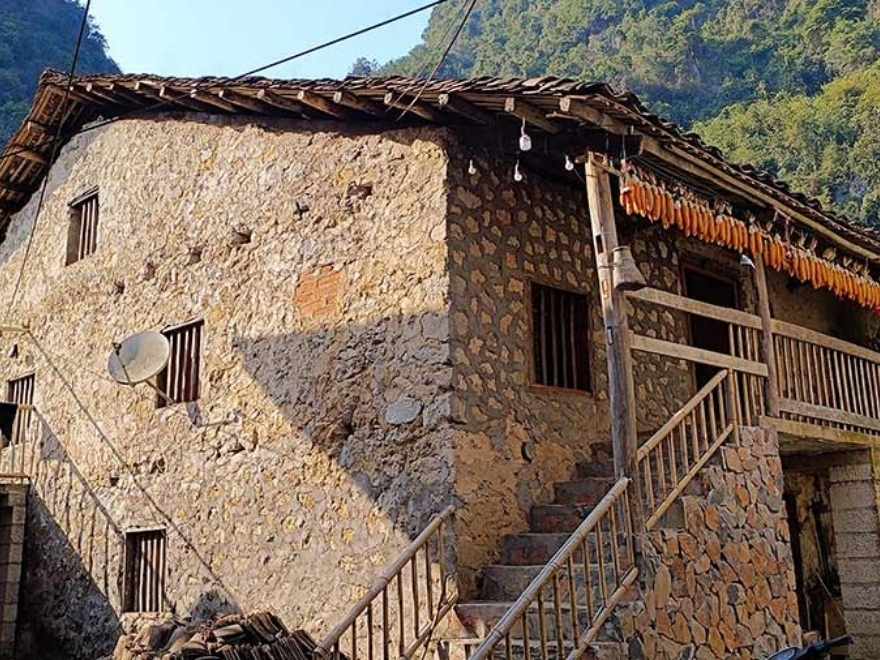
Thick stone walls, wooden living spaces and yin-yang roof tiles define the village's traditional houses.
Building one required carefully selecting stones of different sizes and binding them with a mixture based on lime and sand. A house could take two to three years to complete. The stone fences deserve separate attention: unlike the house walls, many were dry-stacked by hand without mortar.
Stone also carries spiritual meaning for the Tay community. Local beliefs connect it with strength and protection, which helps explain why it became so present in both domestic architecture and village life. In 2008, Khuoi Ky was recognized as a typical traditional cultural village of ethnic minorities.
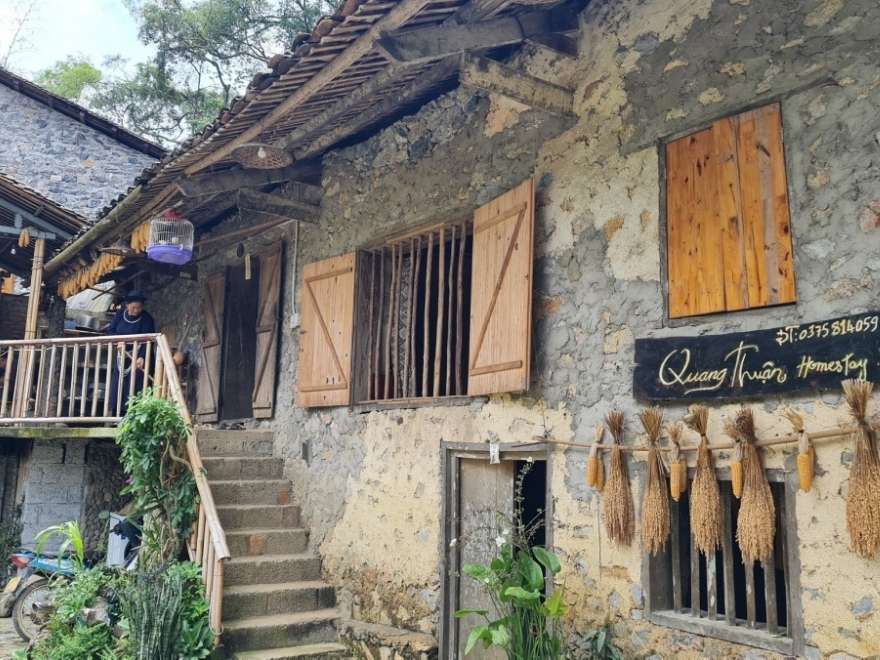
Stone is used throughout Khuoi Ky in walls, steps, fences and family courtyards.
Community tourism became more organized from 2016. In a 2023 interview, village head Nông Ích Đính explained that almost every family participated in tourism. Those that did not host overnight guests provided transport or farm products. Booking a room, meal or local service can therefore support more than one homestay and gives the community an economic reason to keep traditional houses and cultural activities in use.
What can you do during a short visit?
Allow 45 to 90 minutes for a first visit. Our guides usually tell travelers to stop looking for one main attraction. Khuoi Ky makes more sense when you slow down and notice how stone appears in the lanes, fences, courtyards and everyday structures.
- See old stone stilt houses, walls, steps and family courtyards.
- Look for wooden beams, doors and floors set against the heavier stone structure.
- Photograph the houses with the limestone mountains behind them.
- Stop for tea or a short conversation when a host invites you.
- Watch ordinary village life rather than expecting scheduled performances throughout the day.
The village faces Khuoi Ky Stream, where a low dam creates a relatively shallow section. During warm weather, local residents and visitors sometimes swim there. The water is cool, but depth and current can change after rain. I would not enter without first asking a host about conditions, especially after heavy rain or when traveling with children.
Morning is usually quieter and works well for photographs of daily life. Late afternoon brings softer light to the stone walls and roofs.
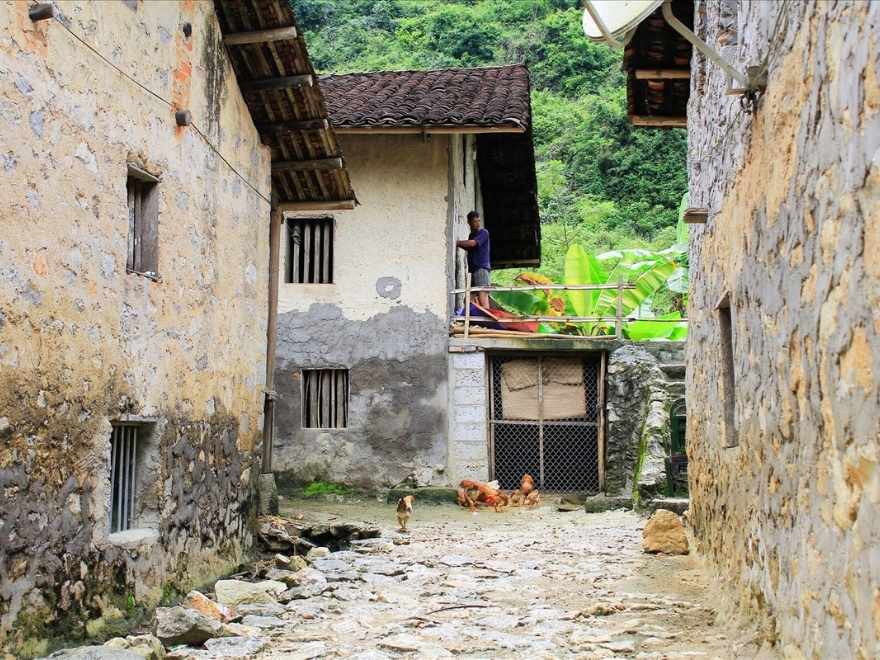
A short visit is best spent noticing the lanes, courtyards and daily details of village life.
What is it really like to stay overnight?
The experience depends heavily on which homestay you choose. Khuoi Ky now has both traditional houses adapted for guests and newer accommodation built with a stone-inspired appearance. They offer very different levels of privacy and comfort.
Staying in an original stone house
This is the detail our team explains most carefully before booking: many of Khuoi Ky's old stone homestays are genuine family homes, not small hotels disguised as traditional houses. In the simplest ones, guests sleep in a shared area divided into sleeping bays by wooden panels or platforms. Bathrooms can be shared and may not be attached to the sleeping area.
I recommend this option to travelers who value the original house experience more than privacy. You remain close to the structure of the house and the daily rhythm of the family, but you need flexibility around sound and facilities. Before booking, ask if the sleeping space is private or shared, where the bathroom is located and if hot water is available.
Choosing a newer, more comfortable homestay
Travelers who want more comfort can choose one of the newer homestays in or near the stone village. These properties often borrow the stone style of Khuoi Ky but provide private bedrooms, ensuite bathrooms and more modern facilities. They offer less of the original house experience, but they are a better fit for couples, families, older travelers and anyone who sleeps poorly in a shared space.
| Criteria | Original stone house | Newer homestay |
|---|---|---|
| Sleeping setup | Often a shared floor or sleeping bays divided by wooden panels | Often a private bedroom |
| Bathroom | May be shared and separate from the sleeping area | More likely to be private or ensuite |
| Comfort | Basic, less private and colder at night | More privacy and modern facilities |
| Main advantage | Sleeping inside a lived-in traditional house | Enjoying the village without giving up essential comfort |
| Best for | Flexible travelers who prioritize cultural experience | Couples, families, older travelers and light sleepers |
Neither option is inherently better. Choose the one that gives you enough comfort to enjoy the stay. Before booking, ask the homestay to confirm a few practical details:
- Request recent photos of the room and sleeping area so you know exactly what you are booking.
- Check if the bathroom is private or shared, where it is located and if hot water is available.
- If you are traveling during the colder months, ask about heating and thick blankets.
- Confirm which meals are included and mention any allergies or dietary requirements in advance.
- Internet access and mobile reception can vary, so ask how reliable they have been lately.
- It is also worth checking if towels and basic toiletries are provided.
Evenings in the village
Evenings are quiet, except when weekend activities are arranged. You can walk through the village, sit by the stream or spend time with your host family. Local residents confirmed in August 2026 that cultural activities are usually arranged on Friday and Saturday evenings. These may include Tay music and dance performances or a campfire. The exact program can still change with the weather and local arrangements, so ask your homestay what is planned during your stay.
The cold is the detail I flag most often. Even when the daytime feels pleasant, a night inside a traditional stone house can feel much colder, especially in winter. Bring warm sleepwear and socks, and check if the homestay provides thick blankets or heating. Even outside winter, a light warm layer is useful after dark.
What food should you expect at a homestay?
Breakfast is usually quick and simple. I prefer to make this clear because a homestay stay does not always mean a large spread of Tay specialties. Depending on the house, breakfast may be instant noodles with sausage and egg, or Cao Bang-style rice rolls.
Dinner is the more memorable meal. Guests commonly eat family-style with the host, sharing local vegetables, rice and seasonal dishes prepared in the house. Stream fish, pork, sausage, bamboo shoots and other Cao Bang ingredients may appear, but the menu depends on the season and what the family has available.
Traditional foods associated with Khuoi Ky include five-color sticky rice, bánh khảo and pẻng phạ. Treat them as dishes to ask about, not a fixed homestay menu.
Some hosts invite guests to help prepare dinner, giving you time together in the kitchen instead of a demonstration arranged only for photographs. Ask in advance if you would like to help cook. Vegetarian meals, allergies and requests to avoid pork should also be discussed before arrival because village kitchens need time to prepare.
How should Khuoi Ky fit into a Ban Gioc itinerary?
Combine Khuoi Ky with Ban Gioc Waterfall and Nguom Ngao Cave. All three can be visited in one day when starting from Cao Bang City or staying near Ban Gioc, although an overnight stay makes the pace more comfortable.
| Place | Main experience | Suggested time |
|---|---|---|
| Ban Gioc Waterfall | Waterfall views, bamboo raft and border landscape | 1.5 to 2.5 hours |
| Nguom Ngao Cave | Cave walk and limestone formations | 45 to 90 minutes |
| Khuoi Ky | Tay architecture and village life | 45 to 90 minutes |
For most of our guests, the smoothest order is Ban Gioc Waterfall, Nguom Ngao Cave, then Khuoi Ky. Ending in the village feels calmer after the two busier attractions.
If you are staying overnight, visit Khuoi Ky in the late afternoon, have dinner at the homestay and see Ban Gioc the next morning. This gives you a quieter evening in the village and avoids squeezing the homestay into an already full sightseeing day.
Travelers with more time can continue through rural Dam Thuy or the Ngoc Con and Phong Nam valleys. For the wider region, use our Cao Bang travel guide to compare the main landscapes, villages and historical sites. The 3-day Cao Bang itinerary is one practical route that includes a night near Khuoi Ky.
How do you get to Khuoi Ky Stone Village?
From Cao Bang City, Khuoi Ky is more than 80 km away and the mountain drive usually takes around two to three hours. A private car, local transfer or motorbike makes it easier to combine the village with Ban Gioc and Nguom Ngao in the same day.
Budget travelers can take a long-distance bus from Hanoi to Cao Bang City, then arrange a local bus, taxi, motorbike taxi or transfer toward the Ban Gioc area. Public transport is possible but less convenient when visiting several places on one day.
From Hanoi, treat Khuoi Ky as part of a multi-day Cao Bang trip rather than a same-day excursion. The journey to Cao Bang City already takes several hours, followed by another mountain transfer to Dam Thuy. The Hanoi to Ban Gioc transport guide compares the main options.
Experienced riders can include Khuoi Ky in a motorbike route, but the roads are mountainous and may be affected by rain, fog or loose gravel. I would only recommend self-riding to someone already confident on mountain roads. Because permit requirements can vary by exact route and nationality, check the Cao Bang border-area permit guide before entering less-visited border sections. A private car or local driver is the easier option for families, older travelers and first-time visitors.
When is the best time to visit?
April to May and September to early November usually offer the best balance of weather and scenery. Spring brings green landscapes and comfortable walking temperatures. Early autumn often has clearer weather, softer light and attractive rice fields around the Ban Gioc area.
June to August is warm and lush, which makes a swim in the village stream more appealing. Rain can raise the water level, make the stream unsafe and leave roads or stone paths slippery. Ask locally before swimming and keep plans flexible.
Winter is quieter but can be cold, damp and grey. This matters much more when staying overnight than during a short daytime visit. Travelers choosing an old stone homestay should pack warm layers and confirm the bedding provided.
For a month-by-month comparison of rain, road conditions and scenery across the province, see the best time to visit Cao Bang.
How can you visit respectfully and safely?
Khuoi Ky is a home before it is a tourist attraction. A respectful visit is simple:
- Ask before photographing people.
- Do not enter houses, courtyards or worship areas unless invited.
- Remove your shoes when requested, and ask before photographing a family altar or private room.
- Keep noise low, particularly in the early morning and evening.
- Carry cash because card payment may not be available.
- Arrange meals and cultural activities in advance instead of expecting them on arrival.
- Support local families through homestays, meals or guiding when these services suit your trip.
Practical questions not to overlook
Is Khuoi Ky a stone-carving village?
No. Khuoi Ky is known for stone architecture, not workshops producing sculptures or stone souvenirs. Its identity comes from the use of stone in houses, fences, lanes and everyday village structures.
Is the village suitable for travelers with limited mobility?
The village is small, but paths can be uneven and some houses have stone steps. A short accompanied visit may be possible, while an original homestay can be difficult for someone who needs level access or an ensuite bathroom. Ask for recent photos of the entrance, room and bathroom before booking.
Do homestays have Wi-Fi and mobile signal?
Some do, but reliability varies by house and conditions. If staying connected is essential, ask the host for a recent update and save offline maps, booking details and contact numbers before leaving Cao Bang City.
Final advice
Visit Khuoi Ky for the culture, not for a long list of attractions. If I had one piece of advice, it would be to choose your homestay carefully. The difference between an old shared house and a newer private room will shape the overnight experience more than the length of your stay.
If you would like to include Khuoi Ky without rushing Ban Gioc and Nguom Ngao, explore the Cao Bang 3-day route, compare the other Cao Bang tours, or contact the local Cao Bang Eco Travel team for an itinerary adapted to your preferred level of comfort.

Have 0 comments, reviews about Khuoi Ky Stone Village: A Centuries-Old Tay Village in Cao Bang
Hello. Please leave a comment, we will respond soon.