

Table of contents
- Pac Bo Cave at a Glance
- What Is Pac Bo Cave?
- Is Pac Bo Cave Worth Visiting?
- Why Is Pác Bó Important in Vietnamese History?
- What Can You See at Pác Bó Historical Site?
- What Else Can You Discover Around Pác Bó?
- How Long Do You Need to Visit Pác Bó?
- How to Get to Pac Bo Cave?
- Pac Bo Cave Entrance Fee, Opening Hours and Facilities
- When Is the Best Time to Visit Pac Bo Cave?
Pac Bo Cave at a Glance
| Visitor question | Quick answer |
|---|---|
| What is the cave's correct name? | Cốc Bó Cave. “Pac Bo Cave” is the name most international visitors use. |
| Where is it? | Trường Hà Commune, Cao Bằng Province, about 52 km north of Cao Bang City. |
| Why is it important? | President Hồ Chí Minh lived and worked here after returning to Vietnam in 1941. |
| Is it a UNESCO site? | No. Pác Bó is a Special National Relic of Vietnam. |
| How much time is needed? | Around 1.5 to 2.5 hours for the main visitor area, excluding travel time. |
| Is the cave physically demanding? | Reaching it involves stone paths and steps. Wet sections can be slippery. |
| Best time to visit | September to May, preferably in the morning. |
| Entrance fee | Free for domestic and international visitors from 4 July 2026. |
What Is Pac Bo Cave?
“Pac Bo Cave” commonly refers to Cốc Bó Cave and, more broadly, to the surrounding Pác Bó Historical Site. This distinction matters because the cave is only one part of a much larger complex.
Cốc Bó means “headwaters” in the local Nùng language. The cave has an area of about 80 square metres and an entrance narrow enough for only one person to pass at a time. President Hồ Chí Minh stayed here from 8 February until mid-March 1941. Before moving into the cave, he spent his first days back in Vietnam at the home of local resident Lý Quốc Súng.
The official heritage record divides Pác Bó into several groups of historical places, including the headwaters area, Khuổi Nặm, the central memorial area and the Kim Đồng historical cluster. It was classified as a national relic in 1975 and received the higher status of Special National Relic in 2012.
.png)
Is Pac Bo Cave Worth Visiting?
Yes, Pac Bo Cave is worth visiting if you are interested in Vietnamese history, President Hồ Chí Minh or quiet mountain scenery. In my experience, it is most rewarding for travelers who want to understand how geography, local support and a remote border position shaped the development of the revolutionary movement.
However, it is important to arrive with the right expectation. Cốc Bó is a historical cave, not a large show cave filled with extensive stalactites and underground chambers. Visitors primarily come for the story, the preserved setting and the walk beside Lenin Stream.
If your main interest is cave geology, Ngườm Ngao Cave near Ban Gioc Waterfall offers a more impressive underground experience. If you want to understand an important chapter of modern Vietnamese history, Pác Bó is the more meaningful choice.
Why Is Pác Bó Important in Vietnamese History?
On 28 January 1941, Nguyễn Ái Quốc, later known as President Hồ Chí Minh, crossed the Vietnam-China border and returned to his homeland after more than 30 years abroad. Pác Bó offered several practical advantages: it was remote, protected by limestone mountains and forests, close to the border and supported by local revolutionary networks.
Here, Hồ Chí Minh and other revolutionary leaders organized training and prepared political and military documents. The Eighth Plenum, held at Khuổi Nặm from 10 to 19 May 1941, prioritized national liberation and led to the establishment of the Việt Minh front.
Pác Bó was therefore more than a temporary shelter. It became an early command base in the years leading to the August Revolution and Vietnam's declaration of independence in 1945. The cave, stone table and poem Tức cảnh Pác Bó also preserve a more personal picture of his simple daily life.
What Can You See at Pác Bó Historical Site?
Lý Quốc Súng’s House
Lý Quốc Súng’s House was the first place where Nguyễn Ái Quốc stayed after returning to Vietnam in 1941. He lived here from the afternoon of 28 January until 7 February, then moved to Cốc Bó Cave, about 100 metres away, for greater secrecy.
The original thatched house disappeared after the family moved away during the French crackdown of 1942 and 1943. Only its foundation remained until the house was reconstructed on its original site in 2019, following its documented layout.
The current rooms and household tools are reconstructions, not objects from 1941. By contrast, the surviving kettle and utensils associated with Hồ Chí Minh’s stay at Cốc Bó are authentic historical objects preserved within the site and museum collections. They are not all necessarily displayed inside the cave.
Cốc Bó Cave
Cốc Bó Cave is the central historical landmark. Its small entrance and concealed position help visitors understand why it was chosen as a secure place to live and work.
Inside are features associated with Hồ Chí Minh's stay, including a sleeping area, a hearth and a place used for work. A date marking 8 February 1941 can also be seen on the cave wall. The interior is compact and cool, so the visit is brief, but the confined space makes the living conditions of 1941 easier to imagine.
This is not a cave for extended underground exploration. Its value comes from its preserved historical setting.
.png)
Lenin Stream and Karl Marx Mountain
Lenin Stream flows below the limestone slope known as Karl Marx Mountain. Hồ Chí Minh gave both places their names during his time at Pác Bó.
The stream is known for its clear blue-green water, particularly during drier months. A walking path follows the water through a shaded area of limestone, trees and small pools. For me, this is the most scenic part of the visit, and I often encourage travelers to slow down here rather than treating it as a quick photo stop.
Swimming and bathing are not permitted. Visitors should also avoid feeding fish or leaving the marked paths.
.png)
The Stone Table Where Hồ Chí Minh Worked
The stone table is located beside Lenin Stream, not inside Cốc Bó Cave. Hồ Chí Minh used this outdoor working place while translating political documents and handling revolutionary work.
Its exposed position beside the water gives physical context to the well-known line from Tức cảnh Pác Bó about working at an unsteady stone table. Visitors may view and photograph the site but should not sit on or touch the protected feature.
Khuổi Nặm Hut
Khuổi Nặm was where Hồ Chí Minh stayed for the longest period at Pác Bó. The small stilt hut stood in a discreet position near the forest, with a clear view outward and an escape route towards the border if danger approached.
The hut is also associated with the Eighth Plenum held in May 1941. Reaching the Khuổi Nặm area requires more walking than the main stream and cave loop, so visitors should allow extra time and ask locally about current access conditions before setting out.
Pác Bó Exhibition House
.png)
The exhibition house gives visitors essential context before or after the outdoor walk. Photographs, documents and displays explain Hồ Chí Minh's return, daily life at Pác Bó and the revolutionary activity that took place in Cao Bằng between 1941 and 1945.
International visitors who are unfamiliar with this period will gain more from the cave after first understanding the timeline. A local guide is especially useful when foreign-language interpretation is limited.
.png)
President Hồ Chí Minh Memorial Temple
The memorial temple stands in the central area of the historical site and was inaugurated in 2011. Its design draws on the traditional stilt-house architecture found in Cao Bằng.
This is a place of remembrance rather than an ordinary sightseeing stop. Dress respectfully, keep voices low and follow local guidance if an official ceremony or group visit is taking place.
.png)
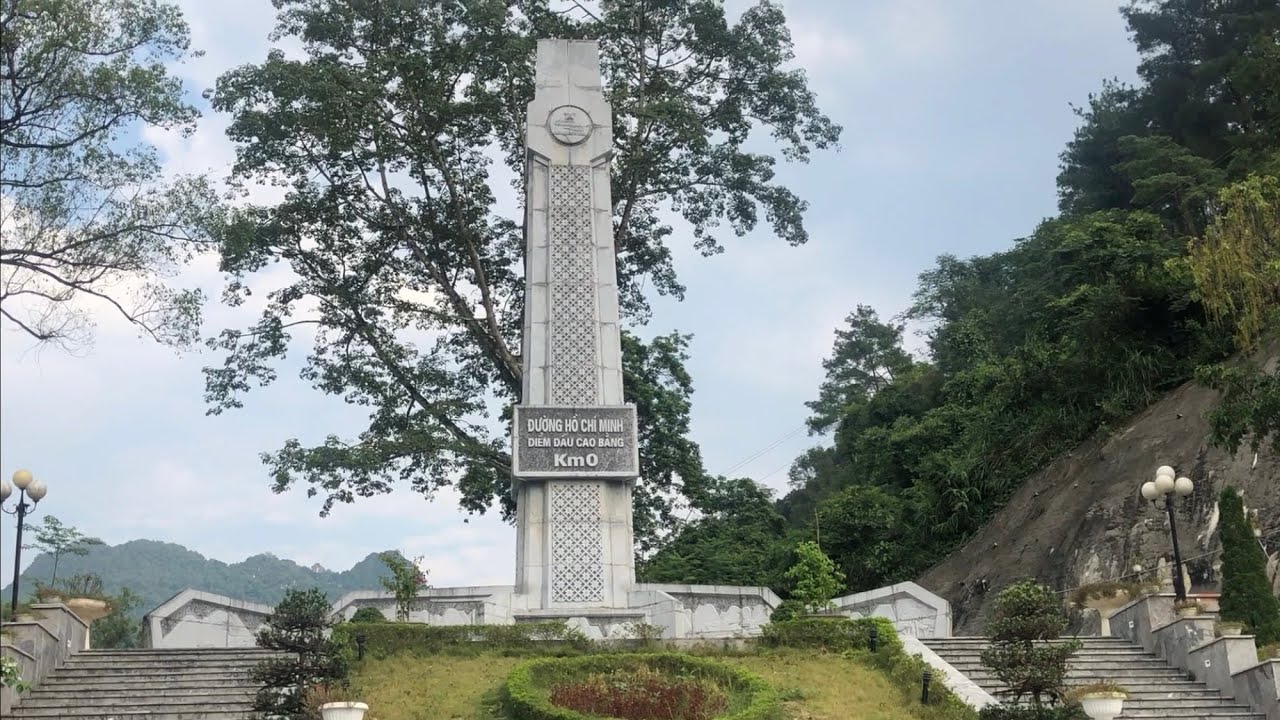
Km0 of the Hồ Chí Minh Road
The Km0 marker identifies Pác Bó as the northern starting point of the modern Hồ Chí Minh Road, which is planned to extend south towards Đất Mũi in Cà Mau.
It should not be described as the historical starting point of the wartime Hồ Chí Minh Trail. The two are connected in name and national memory, but the marker at Pác Bó belongs to the modern road network.
What Else Can You Discover Around Pác Bó?
Historic Border Marker 108 and Legal Marker 675
Only visit historic Border Marker 108 with a local guide. It marks the area where Nguyễn Ái Quốc returned to Vietnam on 28 January 1941. Marker 108 retains its historical value, while Marker 675, about five metres away, identifies the present legal boundary. The climb is separate from the main Pác Bó loop, and access should be confirmed locally.
Near the top, the Chinese side lies immediately to the right of the permitted Vietnamese approach. Do not walk around the markers or cross the boundary for a photograph. An accidental crossing may lead to legal complications, made harder by language differences. A guide can keep you on the correct route and check access conditions on the day.
Kim Đồng Memorial Site
The Kim Đồng Memorial Site is a worthwhile short stop for visitors who want to understand the role of young people in the revolutionary movement. It commemorates Nông Văn Dền, known as Kim Đồng, the first leader of the Children’s National Salvation Team. He was killed at the age of 14 in 1943 after drawing enemy soldiers away from revolutionary cadres.
The site is 2 to 3 km from the main Pác Bó visitor area, around 5 to 10 minutes by road. It contains his grave and a monument showing him in traditional Nùng clothing. Fourteen stone steps and fourteen trees symbolize the fourteen years of his life.
Tày and Nùng Culture Around Pác Bó
Pác Bó is also a living Tày and Nùng cultural landscape, not only a historical monument. Local languages remain in names such as Cốc Bó, meaning headwaters, and Khuổi Nặm, referring to a water stream. Traditional stilt-house forms can also be seen in local architecture.
The early-spring Về Nguồn Pác Bó Festival includes a water-collecting ritual associated with good fortune, favourable weather and a productive year, alongside folk singing, local food and traditional games. Outside the festival, encounters are quieter and take place around villages and fields. Ask before photographing residents or entering a home.
Wildlife in the Wider Pác Bó Landscape
The wider Pác Bó landscape includes limestone forest, moist evergreen vegetation and a spring-fed stream rich in visible aquatic life. Broadleaf trees, bamboo, ferns and mosses shade the main path, while schools of surprisingly large fish can often be seen in Lenin Stream when the water is clear.
The more remote forest is also associated with the Tonkin snub-nosed monkey, Assamese macaque and stump-tailed macaque. Sightings have become increasingly rare, so seeing one would be exceptional rather than expected. Observe wildlife quietly from a distance and never feed it.
How Long Do You Need to Visit Pác Bó?
Allow 1.5 to 2.5 hours for the main area. I usually recommend around two hours for the exhibition space, Lý Quốc Súng’s House, Lenin Stream, the stone table and Cốc Bó Cave. Add extra time for Khuổi Nặm or the Kim Đồng Memorial Site. The climb to Marker 108 is not included in this estimate.
With the drive from Cao Bang City, Pác Bó works best as a half-day excursion.
Recommended Visiting Route
For a clear and comfortable visit, follow this order:
- Begin at the exhibition house to understand the historical timeline.
- Visit the memorial temple in the central area.
- Walk or take the electric shuttle towards the headwaters.
- Follow Lenin Stream to the stone table and Lý Quốc Súng’s House.
- Continue up the steps to Cốc Bó Cave.
- Return along the marked loop.
- Add Khuổi Nặm or the Kim Đồng Memorial Site if time allows.
Walking Conditions and Accessibility
The route includes paved sections, uneven stone paths and steps. Shaded stones can remain damp after rain, so shoes with reliable grip are more useful than sandals.
The electric shuttle shortens the approach but does not remove the steps near Cốc Bó Cave. The cave is not wheelchair accessible, although visitors with limited mobility can still see the exhibition house, memorial area and easier sections near the stream. Children should be supervised beside the water and on wet steps.
How to Get to Pac Bo Cave?
From Cao Bang City
Pác Bó lies about 52 km north of Cao Bang City. The journey usually takes around 1.5 hours each way, depending on weather, traffic and stops along the route.
The most practical options are:
- Private car or taxi: Comfortable for families, older travelers and small groups.
- Motorbike rental: Flexible and scenic, but suitable only for confident riders with the correct licence and insurance.
- Local guided tour: Useful for travelers who want transport and historical interpretation in one trip.
- Local bus: Services may operate towards Trường Hà or nearby settlements, but schedules and final drop-off points can change. Confirm locally before relying on this option.
The road is paved and passes through valleys, farmland and villages. Mountain weather can change quickly, so avoid returning after dark when traveling independently.
From Hanoi
Most visitors travel from Hanoi to Cao Bang City first, then visit Pác Bó as a separate excursion. Coaches, sleeper buses and limousines connect Hanoi with Cao Bằng, while private cars provide more flexibility. Travel commonly takes about 6 to 8 hours, depending on the vehicle and road conditions.
Cao Bằng has no direct railway connection, so a train is not a practical option. For a less tiring journey, stay in Cao Bang City and visit Pác Bó the following morning instead of attempting the entire trip from Hanoi in one day.
Pac Bo Cave Entrance Fee, Opening Hours and Facilities
Admission to Pác Bó Historical Site has been free for both domestic and international visitors since 4 July 2026. According to VOV’s report on the official announcement, the Management Board of Cao Bằng's Special National Relics stopped collecting admission fees at both Pác Bó and the Trần Hưng Đạo Forest historical site from that date.
| Item | Current visitor information |
|---|---|
| Opening hours | 7:30 AM to 5:00 PM daily |
| General admission | Free from 4 July 2026 |
| Eligible visitors | Both domestic and international visitors |
| Motorbike parking | VND 5,000 per motorbike |
| Car or coach parking | VND 20,000 to 40,000, depending on the vehicle's seating capacity |
| Electric shuttle | VND 25,000 per person for a round trip |
Parking, toilets, drinks and simple refreshments are available near the entrance. Carry water because choices are limited inside the walking route.
On-site interpretation and foreign-language availability can vary, so international visitors may prefer to arrange a local guide in advance. Bring shoes with good grip, sun protection and a light rain jacket, and dress respectfully for the memorial temple.
When Is the Best Time to Visit Pac Bo Cave?
Pác Bó is open throughout the year, but September to May generally provides the most comfortable conditions. The weather is cooler, rainfall is lower and the stream is more likely to show its familiar clear blue-green colour.
- September to November: Often the best balance of mild weather, clearer water and comfortable walking conditions.
- December to February: Cooler and sometimes misty. Bring a warm layer, particularly in the morning.
- March to May: Pleasant to warm, with increasing humidity and occasional showers.
- June to August: The main rainy period. The landscape is lush, but paths can be slippery and the stream may become higher or less clear.
I prefer morning visits because the paths are cooler and the site is often quieter. Weekdays are also usually less busy than weekends, public holidays and important national commemorations.
For a province-wide seasonal comparison, see the guide to the best time to visit Cao Bang.

Have 0 comments, reviews about Pac Bo Cave: A Journey to Vietnam’s Revolutionary Roots
Hello. Please leave a comment, we will respond soon.