Phuc Sen Hand-Forged Knives
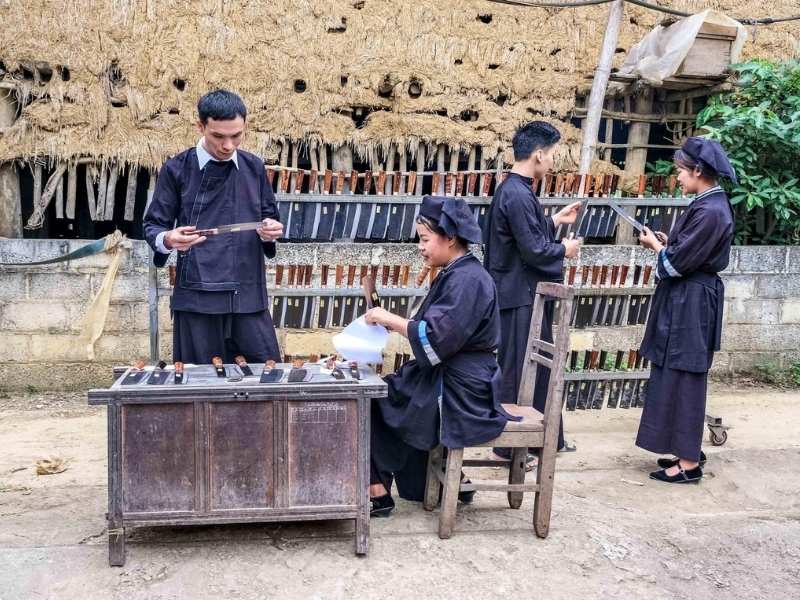
The Nung An ethnic group relocated to Phuc Sen, Quang Hoa (previously Quang Uyen province), Cao Bang city, in the 1800s, where they created a successful forging village. Nestled amid the Non Nuoc Geopark in the northern province of Cao Bằng, Phúc Sen Commune boasts captivating scenery.
The sound of hammer strikes may be heard in every settlement as soon as one arrives at the commune. Elderly locals claim that blacksmithing has been practiced here for hundreds of years. It has been passed down through generations of families, with each household carrying on their ancestors' history.

Phuc Sen Commune currently consists of 11 hamlets and 1,010 houses. More than 200 households are actively involved in blacksmithing. Over half of the hamlets were devoted to the craft in its prime.
Besides the standard forge equipment, such as bellows, anvils, hammers and water troughs, the Nung An people often erect earthen cylinder kilns, around 80cm in height and 60cm in diameter. Thanks to their secret skills, as well as expertise, the Nung An people have developed numerous durable and sharp items.

The forged goods of Nung An people are exceedingly diversified, comprising items such as plow blades, hoe blades, sickles, machetes, shovels, knives, hammers, axes, saws, chisels, and planes. Phúc Sen forged items have formed their own brand and are loved by both local people and visitors alike. The craft has lifted the inhabitants of this area out of poverty, providing them with a more sustainable existence.
- Each product costs between 150,000 VND (~$6 USD) and 1,300,000 VND (~$50 USD).
Nung An Traditional Palm-Leaf Hat (Chup-xa)
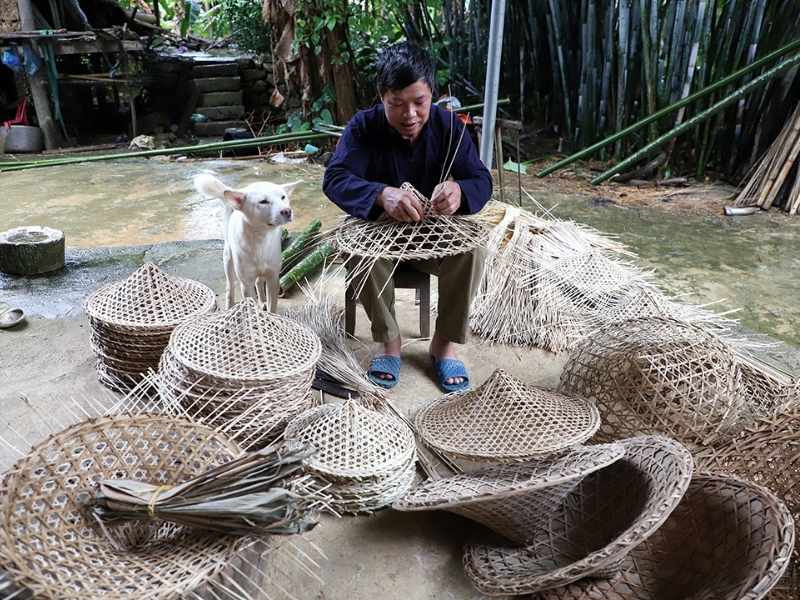
In Hoang Dieu hamlet, Tu Do commune, Quang Hoa district (Cao Bang), 39 Nung An households continue to practice the age-old skill of creating ''chup xa'' conical hats, a custom passed down through generations.
The word ''chup xa'' comes the Nung language and alludes to the hat's characteristic pointed top, which is similar to the ones worn by characters in wuxia films and historical dramas. Its distinctive form has given it the moniker ''warrior's hat.''

Of the 113 homes in Hoang Dieu, 39 still perform the hat-making trade, which is thought to be over a century old. Even village elders cannot trace its roots, yet the skill has always played an important role in supplementing household finances.
Chup xa hats are painstakingly crafted natural materials like may than and may me (similar to bamboo), giang bamboo leaves, and dried banana leaf. These hats are crucial for everyday living, especially for agricultural activity, as they provide shade and protection the weather.
The hat has two layers: an outer frame of may then and an interior weaving of delicate strips may me. These strips must be sun-dried to the proper flexibility and smoothed to minimize harm during weaving and use. A hardwood mold is used to shape the frame equally, while the peak is produced separately to achieve the trademark sharp apex.

The hat's covering, intended to screen the sun and rain, is often constructed of giang bamboo or dried banana leaves, which are carefully chosen for longevity and aesthetic appeal. Skilled craftsmen may make two to three hats each day with brim diameters ranging 30 to 50 cm, which are perfect for protection in fields or woods.
- The price per product might range 80,000 VND (~$3 USD) to 150,000 VND (~$6 USD).
Nung An Indigo Textiles
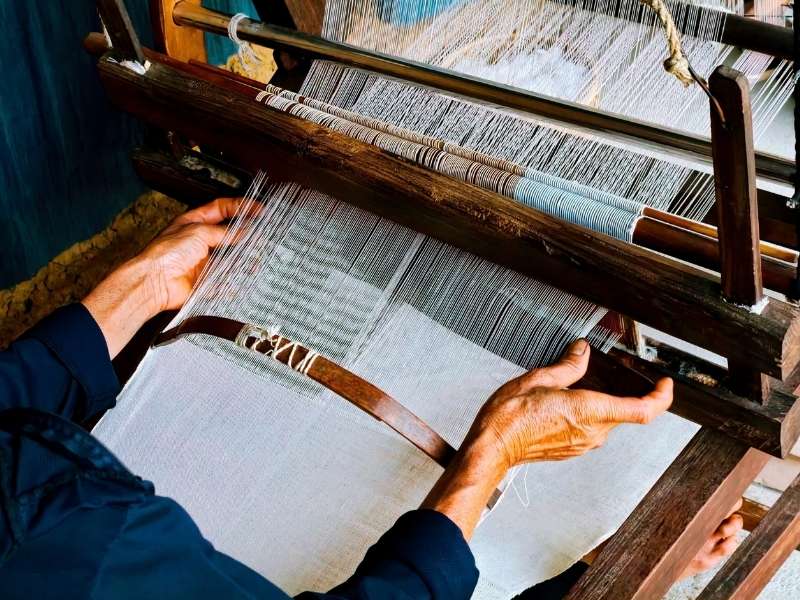
Needlework, such as clothing and embroidery, is significant to Nung women because it exhibits their talent, dexterity, and patience. When a girl marries, she presents homemade blankets and pillows to her husband's residence as a dowry of pleasure. All of the designs on Nung women's clothing are hand-embroidered.
Indigo is a widespread plant in Vietnam's northern regions. Indigo plants are soaked in water, pulverized, and sifted to get indigo powder. Each dyer has their unique method for combining the dyes to get a particular deep blue hue.

The fabric is immersed in indigo dye for about an hour before drying in the sun. The technique is performed multiple times until the fabric reaches the desired hue. Nung women manufacture the majority of their own clothing as well as that of their families.
Sewing and embroidery need precise methods. Normally, they utilize embroidered frames. Flowers, leaves, and the Sun are among the most popular embroidery designs.

The buttons are the focal point of Nung shirts, thus the ladies frequently spend a lot of time producing them attractively and similarly. They also embroider blankets, pillows, and headscarves.
- The price per product might range 300,000 VND (~$12 USD) and above.
Phia Thap Organic Incense
Tucked in Cao Bang Province, Phia Thap Incense Village is known for its traditional incense-making craft and the striking scenes that come with it—bamboo trays, bundles of incense sticks, and seasonal moments when bright colors fan out to dry in the sun.
Incense manufacture varies per household, but frequently involves stages such as:

- Preparing Bamboo Sticks
- Mixing incense powder
- Coating and shaping
- Drying and bundling
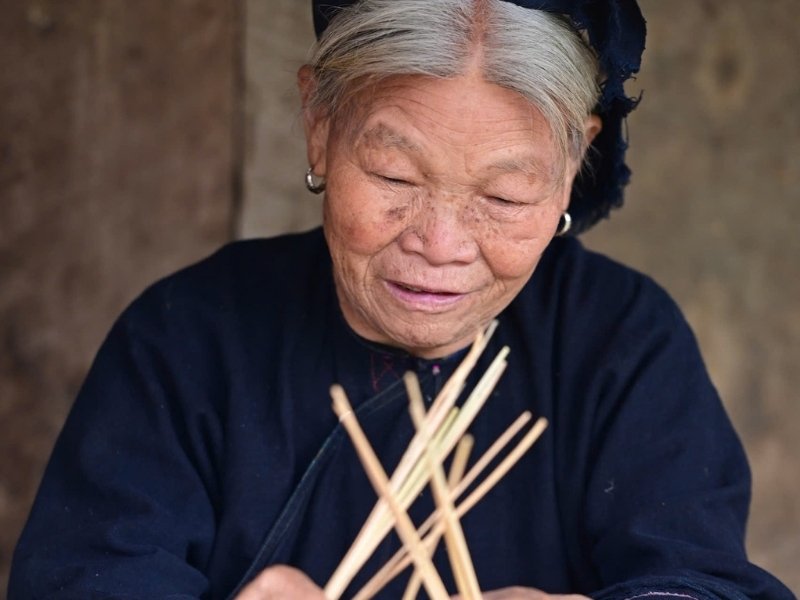
Phia Thap incense is fully created natural materials found in karst regions, such as bamboo trees (''may muoi'' in Tay language) for manufacturing sticks, bombax ceiba tree bark, sawdust, and notably leaves of the wild tree known as ''bau hat'' to generate glue for gluing the ingredients together.
Making incense is not difficult, but it does require numerous steps. The bamboo tree is chopped 40cm-long sections, divided little chopstick-sized bars, and then polished neatly. The ''bau hat'' leaves and barks of the bombax ceiba tree are finely ground and combined with sawdust. Bamboo sticks are soaked in water, which is blended four times with powdered ''bau hat'' leaves to make a glue, and then seasoned with a flour combination of ''bau hat'' leaves, bombax ceiba bark, and sawdust to make incense.
After drying, the sticks are colored red on the bottom half and dried again before being wrapped bundles for sale at fairs.
Dia Tren Poonah Paper (Dó Paper)
Poonah paper is made a variety of trees with green bark.
The process of making poonah paper in Duong O village comprises a series of complicated steps which require not only physical efforts but also skills, experiences and endurance. Nowadays, Duong O villagers produce poonah paper exactly the way their ancestors did.
The process begins with removing the black outer layer bark and drying the remainder. When the bark is completely dried, the papermaker soaks it in a water tank for two or three days to make it softer. The bark is then given a rough clean so that all impurities will be removed.
![]()
Then the bark is cut 40cm-long pieces which will be soaked in condensed lime water for three days, simmered for another day, and then pounded pulp.
The next step is to mix bark pulp, Clerodendrum sap and water a mixture. Noteworthily, the ratio of Clerodendrum sap to bark pulp is a secret that is often handed down father to son in each family.
When the mixture is ready, the step of forming paper sheets begins. The papermaker dunks a wood frame with a screen made of thin bamboo sticks the pulp mixture and seeps it until a perfect layer forms on the top.
The length of paper sheets depends on the size of the frame while their thickness depends on the papermaker’s skills that require accuracy and years of practice. The papermaker then separates the sheet the bamboo screen and stacks it a pile of paper and repeats this movement over and over again.
An experienced papermaker can make 1,300 sheets in one day.
The process continues with the pile of paper being gently squeezed. After that, sheets are peeled off and dried by being either hung over bamboo sticks in dry shady places for two or three days or stuck onto a wall one by one stacks of 30 sheets.
When the sheets become completely dried, they will be peeled off for use.
Ethnic Group Jewelry
Tay and Nung ethnic groups primarily wear silver jewelry, including torque (kiềng cổ), bangles (vòng tay kiềng), and belt chains (xà tích). They think that wearing silver can help you ward off evil and protect yourself illness.
These are easy to find, with prices ranging 100,000 to 500,000 VND each product.
The Taste of Cao Bang
Bitter Tea (Che Dang) - The Wellness Gift
During the Vietnamese Lunar New Year (Tết), Cao Bang Bitter Tea is a traditional herbal drink used by northern mountain cultures to cleanse the body, calm the internal heat, and restore balance. Though the tea seems bitter at first, it quickly reveals a deep, refreshing sweetness, providing a powerful and refined experience.
Cao-bang tea (scientific name: Ilex kudingcha) is a popular beverage in Vietnam. It is also referred to as ''Kuding tea'' in China and ''Tarayo'' in Japan. It is best known in China as a popular bitter nutritious tea that was introduced to the imperial court over 2000 years ago.
According to reports, cao-bang tea contains a high concentration of triterpenoids such ursolic acid and oleanolic acid. Ursolic acid, in particular, has been shown to reduce inflammation and prevent cholesterol deposition on blood vessel walls, which can contribute to arteriosclerosis.
Preparation:
- Place two or three dried leaves in the teapot.
- Boil some water to clean the tea. Then, thoroughly rinse the water.
- Pour in the boiling water and let it sit for five to seven minutes until the tea has infused.
- Enjoy your tea.
The pricing is 40,000 VND (~$1.5 USD) per pack of 100 gr.
Khau Sli
Khẩu Sli is a traditional meal relished during vacations and Tet celebrations by the Tay and Nung people of Cao Bang. In the local dialect, Khẩu Sli means popped sticky rice cake, also known as puffed rice cake with peanuts.
Khẩu Sli is a traditional recipe prepared with native ingredients such sticky rice, peanuts, and palm sugar. It is made by hand in multiple phases, including heating the sticky rice, smashing it, mixing with block sugar, and sprinkling peanuts.
After preparation, two layers of the cake stick firmly together, providing a crispy texture with the sweetness of palm sugar, the perfume of popped rice, and the rich flavor of peanuts, making a lasting impression on anybody who tastes it.
Khẩu Sli, a traditional cake in Cao Bằng, is given as a present and welcomed guests. During the traditional Tet celebration, alongside Bánh Chưng and Bánh Khảo, a couple packs of Khẩu Sli are essential on the ancestral altar.
Khẩu Sli is now a specialty of Cao Bằng. Visitors all around purchase several packs to bring home as gifts for family and friends to enjoy together.
Prices for Khẩu Sli Nà Giàng range 20,000 VND (~$0.8 USD) to 25,000 VND (~$1 USD) per pack, while the boxed version costs 35,000 VND (~$1.4 USD) per box.
Trung Khanh Chestnuts
Chestnuts are a delicacy of Trung Khanh District, Cao Bang Province, due to their huge size, thick shell, golden, tasty, and nutty flesh, and high nutritional value.
Trung Khanh chestnuts are produced in high mountainous regions with a cool environment and plenty of streams and rivers, creating ideal circumstances for the trees to flourish. This setting adds to the higher quality of Trung Khanh chestnuts compared to those grown in other regions.
Harvesting is normally done in September and October each year.
The preparation of Trung Khanh chestnuts is straightforward. To make roasted chestnuts, first properly wash and drain them. Then, set the chestnuts in a skillet over low heat and roast until golden and aromatic. For boiled chestnuts, thoroughly rinse them before cooking them in boiling water until soft. Remove the water and enjoy.
How to Enjoy Trung Khanh Chestnuts?
- Boiled Chestnuts: This is the most basic approach to savor the original flavor of chestnuts. Boiled chestnuts are delicate, fragrant, and easy to eat.
- Roasted Chestnuts: Roast chestnuts on a skillet or in the oven. When roasting, toss them evenly to ensure they cook evenly and do not burn. Roasted chestnuts have a crunchier texture and a deeper scent than boiling chestnuts.
- Dried Chestnuts: This method of preparation allows chestnuts to be stored for longer periods of time than boiling or roasted ones. Chestnuts can be dried in the microwave or with a food dehydrator. Dried chestnuts can be eaten alone or used in baking, pastries, and other cuisines.
Where to Buy?
- Cao Bang local market days
- Cao Bang Specialty Store: 72 Vuon Cam, Hop Giang Ward, Cao Bang.
- Cao Bang Specialty - Hoang Nam: Culinary Market, Kim Dong Street, Hop Giang Ward, Cao Bang.
- Cao Bang Specialty - CB GREEN: 206 Ban Khuong Coc Chia, Doai Duong Commune, Trung Khanh District, Cao Bang.
FAQs
Can I bring Phuc Sen knives on an international flight?
Yes, you can bring Phuc Sen knives on an international flight, but only as checked luggage. Security standards in Vietnam and around the world strongly ban carrying any form of knife in cabin luggage.
Follow these important rules to safely transfer them:
- Knives must be stored within checked luggage. They must be inaccessible during the journey.
- Safe packaging: Wrap the blades securely in bubble wrap, heavy cardboard, or a sheath to keep them slicing through your luggage and endangering the baggage handler.
- Announce if necessary: While not always needed depending on your location, it is a good idea to announce that you are carrying sharp equipment when dropping off your bags.
- Verify destination customs: Check that the country you're flying allows the importing of forged or hunting knives.
You cannot bring carry-on bags on board. Instead, contact one of the blacksmith studios in Phuc Sen hamlet; many artisans and local businesses may arrange for your keepsakes to be securely transported directly to your home.
How can I tell if the Trung Khanh chestnuts are authentic?
- Size and shape: Authentic Trung Khanh chestnuts are huge, frequently the size of a chicken egg, and have a spherical, plump appearance.
- The Shell: Look for a thick, firm shell that is dark brown and extremely glossy. Genuine variations feature fine, light-colored fuzz (down) near the tip.
- The Kernel: When peeled, the inside meat should be deep, dark yellow (golden), not pale.
- Flavor Profile: Real nuts are highly fragrant, buttery, and have a rich, sweet, nutty flavour.
- Harvest Season: Genuine Trung Khanh chestnuts are often harvested in the fall, notably in September and October. If you acquire them outside of these months, be sure they have been stored properly.
To avoid purchasing counterfeit or low-quality imported chestnuts, go straight to recognized local markets in Cao Bang or trusted area sellers.
What is the best ''zero-weight'' souvenir?
Chup-xa, our authentic type of bamboo hat.
Where can I find the most authentic indigo textiles?
- Hoài Khao Village (Nguyên Bình District) The Dao Tiền people
- Phù Ngọc & Khào Hamlets (Quảng Hòa District) Nùng An ethnic
- Lũng Niếc & Lương Nỗi Villages (Hà Quảng District) Tày ethnic
Conclusion
Shopping in Cao Bằng allows visitors to experience the region's rich culture and heritage at home. Whether you choose authentic hand-woven brocade made by local ethnic minorities, a hand-forged chef's knife the Phuc Sen Blacksmith Village, or specialty agricultural treasures such as Trung Khánh chestnuts and smoked meat, these keepsakes provide a tangible memory of Vietnam's breathtaking northeastern frontier.
Have 0 comments, reviews about What to Buy in Cao Bang: Authentic Souvenirs & Local Crafts
Hello. Please leave a comment, we will respond soon.