
Table of contents
- Bao Lac in brief: where it is and why older maps show different names
- What Bao Lac is known for
- What to do in Bao Lac
- How to get to Bao Lac
- Best time to visit Bao Lac
- Where to stay: town guesthouse or Lo Lo homestay
- What to eat in Bao Lac
- Self-ride, easy rider or car: which suits this stretch
- Is Bao Lac worth a stop? Bao Lac, Meo Vac and Bao Lam compared
- Practical notes before you go
- Riding this stretch with us
Bao Lac in brief: where it is and why older maps show different names
Bao Lac lies in the western part of Cao Bang province, about 130 km Cao Bang city along National Highway 34, in a valley on the Gam River. It is the natural halfway point between Meo Vac and Cao Bang city, which is why riders crossing between the two loops end up here.
One detail matters when using older maps and booking sites: Bao Lac district no longer exists. On 16 June 2025 the Standing Committee of the National Assembly issued Resolution 1657/NQ-UBTVQH15, restructuring Cao Bang 56 commune-level units. 1 July 2025 Vietnam runs a two-tier system of province and commune, and the district layer was removed nationwide. The former Bao Lac town, Bao Toan commune and Hong Tri commune were merged a single new commune, also called Bao Lac, directly under Cao Bang province.
Two other names in this guide changed at the same time. Xuan Truong, where the Khau Coc Cha pass is, absorbed Hong An commune and kept the name Xuan Truong. Kim Cuc, home to the Lo Lo village of Khuoi Khon, was merged with Hung Thinh and Hung Dao a commune now called Hung Dao. If you are still deciding how the western side of the province fits your route, our Cao Bang travel guide sets out the wider picture first.
???? Good to know
Older signage, booking sites and blogs still say ''Bao Lac district'' and ''Kim Cuc commune''. Nothing on the ground moved, only the administrative labels. If a guesthouse listing or a bus ticket uses the old wording, it is not out of date in any way that affects you.
What Bao Lac is known for
Bao Lac is known for four things: a traditional market that runs on a five-day lunar cycle rather than a fixed weekday, the Khau Coc Cha pass with its 14 hairpins stacked 15 tiers, the Black Lo Lo community at Khuoi Khon, and its position as the only real overnight town between Meo Vac and Cao Bang city.
What it is not known for is a list of attractions. There is no cable car, no ticketed viewpoint in town, no restaurant strip. The reason to stop is that the valley still functions as a working highland town rather than a stop built for visitors, and that the surrounding roads are quiet in a way the Dong Van plateau stopped being years ago.
What to do in Bao Lac
Plan around three fixed points: the pass, the market cycle, and one village visit. Everything else in Bao Lac is unstructured riding and walking. A full day covers the pass and a village comfortably. Two days lets you add a market morning if the lunar dates line up with your route.
Khau Coc Cha Pass, also called Me Pia
Khau Coc Cha, also known locally as Me Pia, is one of the main reasons riders add Bao Lac to their route. It is the same mountain pass, not two separate attractions.
The important planning point is that Khau Coc Cha is not on the standard route Meo Vac to Bao Lac. It is reached Bao Lac toward Xuan Truong, so you need to add it deliberately as a detour or include it in a longer route toward Cao Bang city.
For the full pass guide, including the viewpoint, road details and practical riding information, see our Khau Coc Cha Pass guide.
The market: a five-day cycle, not a weekday
Bao Lac market runs on the 5th, 10th, 15th, 20th and 25th day of each lunar month, with some sources adding the 30th. It is not a Monday market and it is not a night market, two claims that circulate widely in English. The market sits on a small street in the centre of town, the Gam River on one side and a row of houses against the rock face on the other.
Because the schedule is lunar, the calendar dates shift every month. Check a Vietnamese lunar calendar converter for your travel dates before you commit to a market morning, or ask your accommodation the day you arrive. Trading starts early, and the first hours after dawn are when Tay, Nung, Mong, Dao and Lo Lo traders the surrounding hills are actually there.
There is also a festival version. The Phong Luu love market, known locally as Hang Toan or Hang Phung Liu, traditionally falls twice a year, on the 30th day of the third lunar month and the 15th day of the eighth lunar month, with courtship singing between Tay, Nung, Mong, Dao Do and San Chi groups. Whether the full public festival programme runs in 2026, and who now organises it after the district layer was dissolved, is not something we can confirm. Treat the traditional dates as reliable and the event scale as unconfirmed.
Khuoi Khon and the Black Lo Lo villages
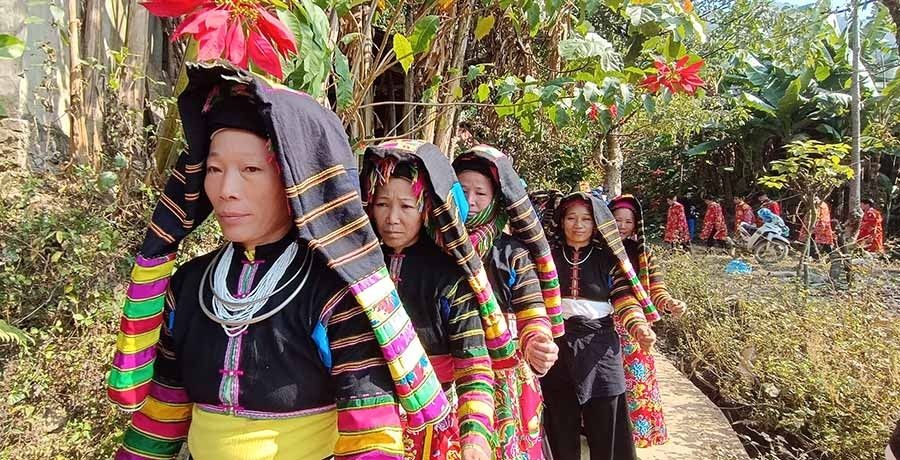
Khuoi Khon is a Black Lo Lo hamlet about 16 km Bao Lac town, in what is now Hung Dao commune. It has around 60 Lo Lo households living in stilt houses with yin-yang tiled roofs, and it is the one village in the area organised for visitors, with five homestay households and a community house completed in March 2021 that displays Lo Lo textiles, looms and a bronze drum model.
This is a community tourism project supported by a provincial conservation scheme, not a spontaneous open village. Practically, that means you can arrange to stay, eat and join daily work such as weaving or cattle care, and it also means arriving unannounced is less useful than booking ahead through a guesthouse or operator. October and November are among the busiest months at the homestays, so contacting your host before arrival is recommended.
Other Lo Lo, Tay and Nung hamlets sit along the tracks radiating town. These are ordinary working villages with no visitor arrangement. Riding through is fine, entering houses or photographing people is not, unless you are invited or accompanied by someone the village knows.
Quiet riding around the Gam River valley
The roads out of Bao Lac in every direction are the most underrated part of the stop. The Gam River corridor toward Ly Bon, the climb toward Xuan Truong and the Dong Mu valley, and the tracks up toward the Lo Lo hamlets all give you empty asphalt, terraced slopes and karst ridgelines without a single tour bus.
There is no named must-ride loop here, and that is the point. Pick a direction after breakfast, ride two hours, turn back. If you would rather have someone who knows which tracks are rideable after rain, this is exactly the kind of terrain where a local rider earns their fee, and it is why our Cao Bang to Ha Giang tours run the Khau Coc Cha side rather than only the main highway.
How to get to Bao Lac
Bao Lac connects three ways: Meo Vac at the end of the Ha Giang Loop, Cao Bang city along Highway 34, and directly Hanoi by bus. Distances below are road distances, not straight lines, and highland riding times run longer than the kilometres suggest.
| Route | Distance | Typical time | Road |
|---|---|---|---|
| Meo Vac to Bao Lac | ~75 km | 2.5 to 3.5 hours riding | QL4C to Ly Bon bridge, then QL34 |
| Bao Lac to Cao Bang city | ~130 km | 3.5 to 4.5 hours | QL34 via Nguyen Binh |
| Bao Lac to Khau Coc Cha pass | short detour north | allow half a day with the walk | QL4A toward Xuan Truong |
| Hanoi to Bao Lac | ~300 km | about 6 to 7 hours by bus | direct sleeper and 16-seater services |
Meo Vac and the Ha Giang Loop
The standard route leaves Meo Vac on Highway 4C heading east, drops through Niem Son toward the Ly Bon bridge over the Gam River after roughly 50 km, then turns onto Highway 34 for the final 25 km or so east Bao Lac. Total is around 75 km, and most riders take three hours with stops.
Note what this route does not include. You do not cross Khau Coc Cha on the way Meo Vac. The 15-tier pass sits on the road running north Bao Lac toward Xuan Truong and on toward Thong Nong, so reaching it is a deliberate out-and-back town or a longer alternative route to Cao Bang city. Several guides imply the pass is simply on your way. It is not, and riders who assume otherwise ride straight past the thing they came for.
Cao Bang city
Highway 34 runs southwest Cao Bang city through Nguyen Binh and the old Tinh Tuc tin mining town, reaching Bao Lac after about 130 km. This is the surfaced main road and the one buses use. Allow four hours and more in wet weather, when highland sections of QL34 are the first to suffer.
The alternative is the eastern back road through Thong Nong, Xuan Truong and over Khau Coc Cha Bao Lac. It is considerably longer and the surface is mixed, but it is the way to take the pass in one direction rather than doubling back. Either way you will start or finish in the city, so it is worth knowing what there is to do in Cao Bang city on the night either side.
Hanoi
There are direct bus services Hanoi to Bao Lac, mostly 16-seaters and sleepers, with several departures spread through the day and a journey around six hours. Published fares on this route sit near 250,000 VND, though we have not verified current pricing with those operators, so treat that as a reference point rather than a quote and confirm when you book.
The alternative is a Hanoi to Cao Bang city bus, a far busier route with limousine and sleeper options running through the day and taking roughly five to six hours, then a local connection west to Bao Lac. Use this if timings for the direct service do not suit you. We can arrange bus tickets in either direction if you are already booked with us.
Best time to visit Bao Lac
Late September to November is usually the strongest window for Bao Lac. The terraced rice around Bao Lac and neighbouring Bao Lam turns gold before harvest, rainfall generally decreases, and mountain roads are usually easier to ride. This is also the busiest period at the Khuoi Khon homestays, so book ahead rather than arriving on spec.
March to May is the quieter alternative, green and warming, with far fewer visitors. December to February brings genuine cold at this elevation along with morning fog on the passes, which matters more than the temperature does: start riding days late enough for visibility to lift.
June to September is the wet season and the one to plan around carefully. Landslides and washed sections are normal on QL34 and on the mountain roads toward the Lo Lo villages, and conditions change within a single day. Riding here in that window is possible but is the case where local road knowledge stops being a nice extra.
Where to stay: town guesthouse or Lo Lo homestay
You have two genuinely different options in Bao Lac, and they suit different trips. Guesthouses in town are functional and close to food and the market street. The Khuoi Khon homestays 16 km out are the reason some people come to Bao Lac at all. Choose by what you want the evening, not by price.
| Guesthouse in Bao Lac town | Homestay in Khuoi Khon | |
|---|---|---|
| Best for | Late arrivals, early market starts, riders on a schedule | Travellers who want an evening and a morning inside a village |
| What you get | Private room, private bathroom, secure bike parking | Stilt house sleeping, family meals, weaving and daily work |
| Booking | Often walk-in; town rarely fills | Arrange ahead, especially October and November |
| Trade-off | No cultural content, purely a bed | 16 km of mountain road each way, shared living space |
Places that were operating at the time of writing, all within walking distance of the market unless noted: Viet Hoang Hotel in Khu 6, the most consistently recommended by riders, with river-facing rooms and covered overnight bike parking. Khach San Mien Tay, newer and with an English-speaking owner. Thuy Duong Hotel, about 100 m the market with river views on one side. PaoLo Hotel in To Dan Pho 4, straightforward and centrally placed. Out at the village, Homestay Khuoi Khon 3rd Stay is the best known of the Lo Lo households, with a steep final climb and dinner worth ordering ahead.
Rooms in town are basic and rarely sell out, so booking days ahead is not usually necessary. The homestay is the opposite: contact it before you ride up, especially in autumn. If you are mapping out the whole route rather than just this night, our guide to where to stay in Cao Bang covers the other stops on the loop.
What to eat in Bao Lac
Eat at the market stalls and the small restaurants along the main street. The food here is highland Tay and Nung home cooking rather than a restaurant scene, and the market food section is where the range is widest on trading days.
Cao Bang specialities worth ordering when you see them include khau nhuc, slow-braised pork belly served at Tay and Nung celebrations, sticky rice cooked with black canarium fruit in late autumn, and rau bo khai, a wild mountain vegetable with a distinctive flavour that grows on limestone slopes. Ant egg cake, made with glutinous rice flour and fig leaves, appears only around April and May.
Self-ride, easy rider or car: which suits this stretch
The Bao Lac section is harder than the eastern Cao Bang Loop around Ban Gioc, mainly because of distance between fuel stops, patchy signal, and mountain road that changes with the weather. How you cover it should follow your riding experience and the season, not your budget alone.
Self-ride suits confident riders with real mountain experience, travelling in the dry months, comfortable navigating on roads where signposting thins out. You will want offline maps, a full tank leaving each town, and a plan that gets you in before dusk. Bikes range 110cc automatics to a 150cc or 190cc manual for the longer stretches; the choice matters more here than on flat routes, and our motorbike rental page lists what is available and what each type handles.
An easy rider makes the biggest difference in two situations: the wet season, when knowing which sections are currently damaged is the whole job, and village visits, where a guide who is known locally changes what you are shown and what you are allowed to photograph. You still ride the whole route, on the back.
A car or jeep is the option for travellers who do not ride, families, or anyone linking Ha Giang and Cao Bang who wants the landscape without seven hours in the saddle. You lose the small tracks toward the Lo Lo hamlets and keep every pass and viewpoint.
If you are short on time, the honest answer is that Bao Lac is the part to cut. Five days or fewer is better spent riding the Ha Giang Loop or the eastern Cao Bang Loop properly than rushing both.
Is Bao Lac worth a stop? Bao Lac, Meo Vac and Bao Lam compared
Bao Lac is worth a night if you are crossing between Ha Giang and Cao Bang and you value quiet over amenities. It is not worth a dedicated trip Hanoi unless the market, the Lo Lo villages or the pass are specifically what you came for. On a five-day trip or shorter, skip it and ride one loop properly instead.
Against Meo Vac, the comparison is straightforward. Meo Vac has more accommodation, more English spoken, more places to eat and a larger, better-known Sunday market. Bao Lac has a fraction of the visitors and a market that operates for its own community rather than for an audience. If you want a comfortable evening, stay in Meo Vac. If you want a quiet one, ride on.
Against Bao Lam, the neighbouring area to the west, Bao Lac wins on access and on things to build a day around. Bao Lam is greener and even less visited, but it has no equivalent of Khau Coc Cha and no organised community tourism village, so it works better as scenery you pass through than as a base.
Practical notes before you go
Six things matter more here than they do further along the loop, and all of them are easier to sort out before you leave Meo Vac or Cao Bang city.
- Cash. Bring what you need for the stay. ATM coverage in a town this size is limited, guesthouses and market traders deal in cash, and the nearest reliable machines are back in Cao Bang city.
- Fuel. Fill up before the Ly Bon stretch and again before heading north toward Xuan Truong. Stations thin out badly between towns on both roads.
- Signal and navigation. Coverage is patchy across the valleys. Download offline maps before you leave a larger town, and tell someone your rough plan for the day.
- Safety. Bao Lac is a low-risk place in terms of crime, including for solo travellers and solo women, and the practical risks here are road and weather related rather than personal: fog, wet surfaces, loose gravel on repaired sections, and animals on the road. Ride slower than the road looks like it allows, and do not push dusk.
- Etiquette in villages. Ask before photographing anyone, do not hand money or sweets to children, and stay out of the way of trading at the market. Goodwill toward visitors in these valleys is real and it is not guaranteed to last if it is treated carelessly.
Licence, insurance and riding legally as a foreign visitor
Before renting a motorbike in Bao Lac, check your home licence, International Driving Permit requirements and insurance conditions. A rental shop allowing you to take a bike does not automatically mean you are legally covered to ride.
Enforcement and paperwork rules change, and this is one of the areas where an out-of-date blog post costs real money. Confirm current requirements with your own licensing authority and insurer before you travel. If your licence situation does not allow you to ride legally, an easy rider or a car solves the problem rather than working around it, and that is the reason we ask about it before confirming a self-ride booking.
???? Good to know
Enforcement and paperwork rules change, and this is one of the areas where an out-of-date blog post costs real money. Confirm current requirements with your own licensing authority and insurer before you travel. If your licence situation does not allow you to ride legally, an easy rider or a car solves the problem rather than working around it, and that is the reason we ask about it before confirming a self-ride booking.
Riding this stretch with us
Cao Bang Eco Travel is a licensed local operator based in Cao Bang city, running motorbike rentals, self-ride support, easy rider trips and camping across the province, including the Bao Lac and Khau Coc Cha side of the route. If you are weighing up whether to ride it yourself or go with someone who knows which roads are holding up this month, send us your dates and route and we will tell you straight.
See our Cao Bang and Ha Giang motorbike tours, check motorbike rental in Cao Bang, or ask us about the Bao Lac route.


Have 0 comments, reviews about Bao Lac 101: The Essential Stop Between Ha Giang and Cao Bang
Hello. Please leave a comment, we will respond soon.