
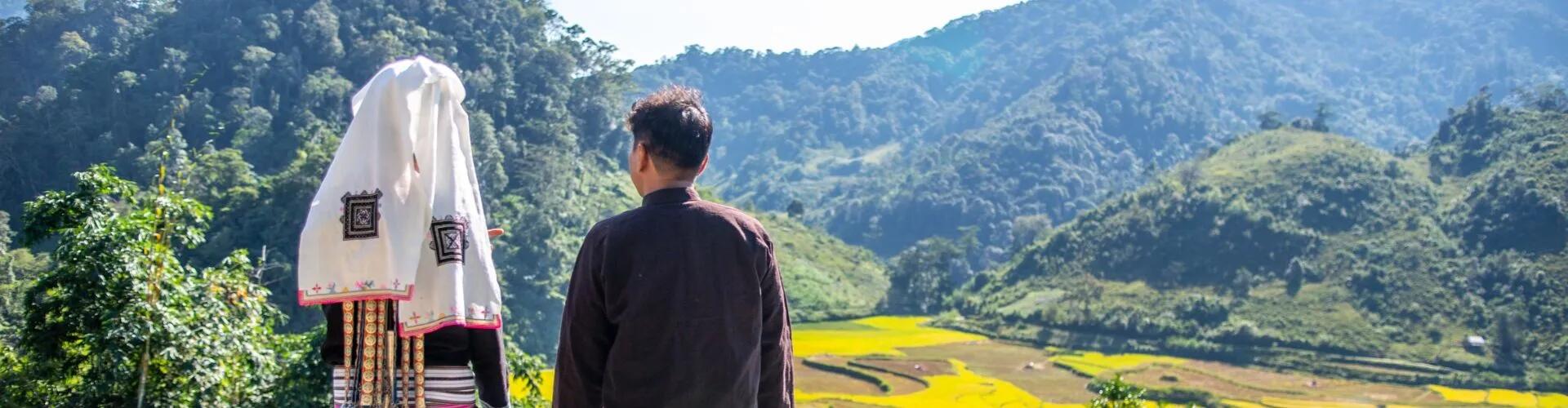
Where is Hoai Khao village?
Hoai Khao is a Dao Tien community tourism village in Thanh Cong commune, Cao Bang province (formerly Quang Thanh commune, Nguyen Binh district). It sits among the mountains of Phja Oac - Phja Den at almost 1,000 m, about 60 km Cao Bang City and roughly 20 km Nguyen Binh. Since 2025 Nguyen Binh is no longer a district, but most people still search for it as ''Hoai Khao Nguyen Binh''. The village has 34 households, all Dao Tien, seven of which run homestays (Vietnam National Authority of Tourism, as of early 2026).
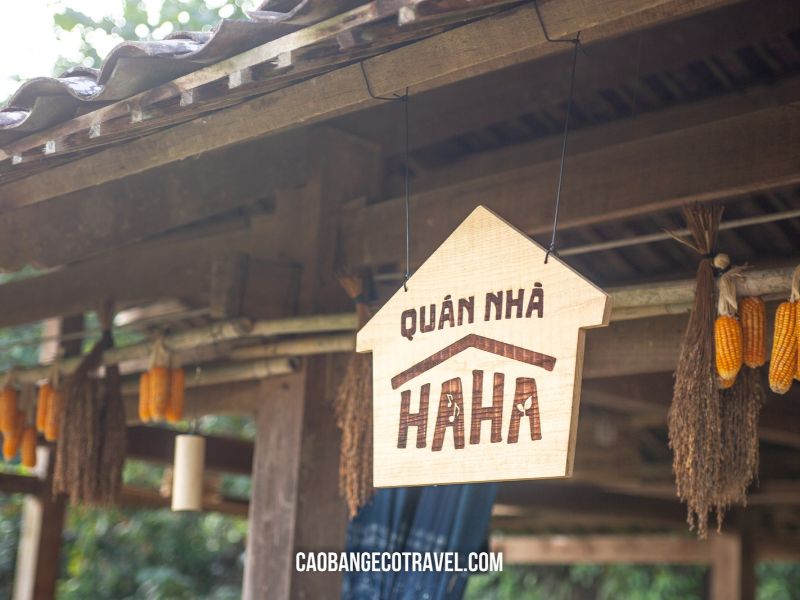
What sets Hoai Khao apart is that nothing here was built for visitors. The tourism works off what the village already does: the wooden houses, the beeswax printing, the silver work and the forest around it.
Is Hoai Khao worth the detour?
Yes, if you want a half day or a night in a working Dao Tien village and you are willing to ride 60 km off the standard Cao Bang Loop to get there. No, if you are on a tight three-day loop built around Ban Gioc, Nguom Ngao and the Angel Eye Mountain, because Hoai Khao sits on the opposite side of the province and adds a full day.
Hoai Khao suits travellers who are interested in craft and daily life rather than headline sights. It became a community tourism village in October 2020, and local authorities told VOV in 2024 that it receives roughly 400 to 600 visitors a year, only a small share of them foreign. There is no ticket gate, no performance schedule and no souvenir street. Taken together, those numbers and that absence are the measure of how little tourism has reshaped the place: Hoai Khao still runs on farming, craft and its own calendar rather than on visitors.
The Dao Tien of Hoai Khao
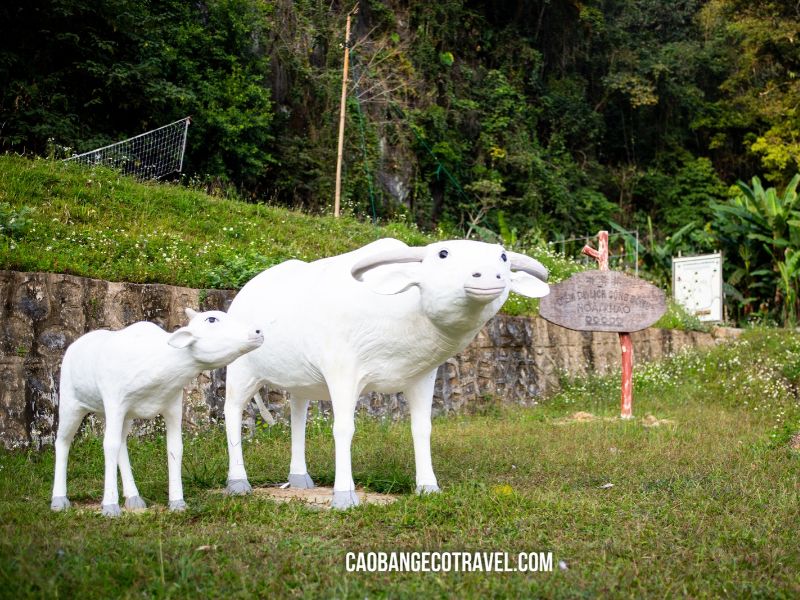
The village was once called Vai Khao, which means white buffalo in Dao, and a statue of a buffalo and her calf still stands at the entrance. The name Dao Tien (''coin Dao'') comes the silver coins stitched onto traditional dress; they are the only Dao subgroup whose women wear skirts patterned with coin motifs.
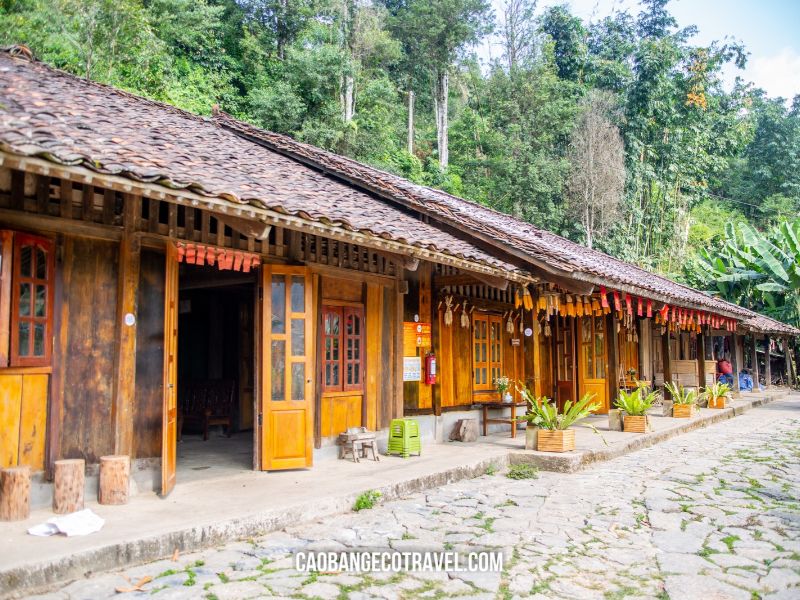
Walking the village takes under an hour, and three things are worth stopping for. The wooden houses have three to five rooms under yin-yang tile roofs. The grain stores stand apart the main houses, and the village chief explains the reason plainly: if the house burns, the family still has food. And there is an old nhoi tree (Bischofia javanica) that the villagers protect and worship, recognised as a Vietnam Heritage Tree in September 2020. The tree is a place of worship, so keep your voice down if you stop to photograph it.
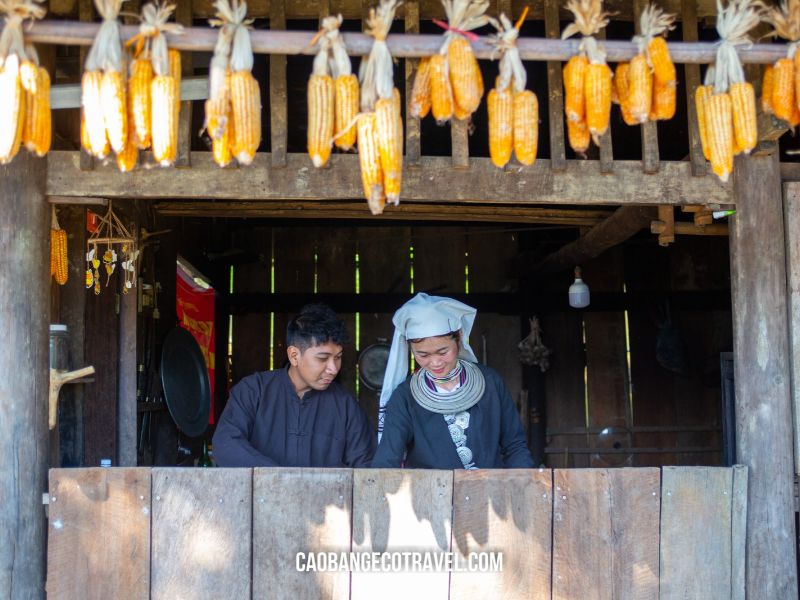
Women here wear indigo jackets and skirts printed with white patterns, and girls begin learning beeswax printing at around ten. You may hear Pao Dung singing if the village organises an evening exchange. The cap sac ceremony, the Dao coming-of-age rite, usually falls in the 11th or 12th lunar month or in the first and second months of the lunar new year, once the harvest is in. It is a religious rite held for a family, not a show, so attend or film only if the household invites you.
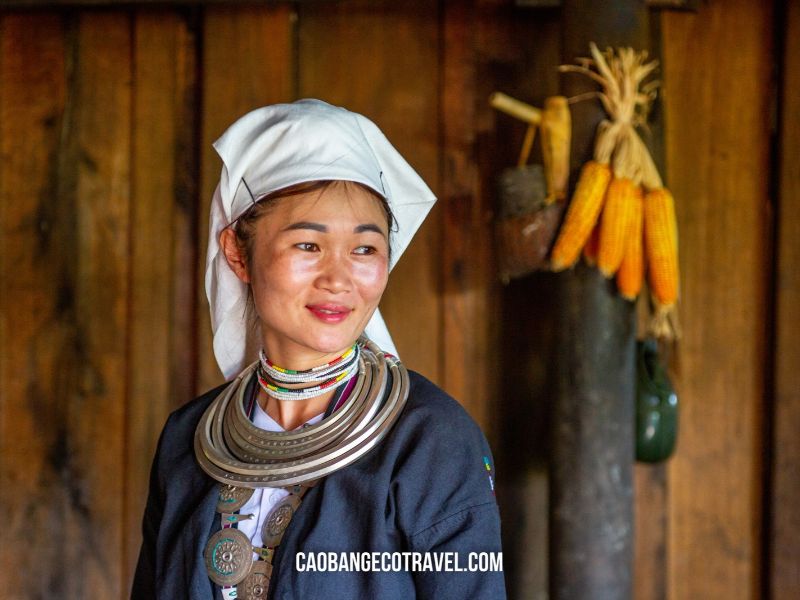
What is cap sac? It is the rite that marks a Dao man as an adult, usually performed after he marries. The Dao believe that life runs smoother and work goes better once a man has been through it.
What to do in Hoai Khao
Hoai Khao is not a sightseeing stop with a list of attractions. What you do here depends on how much time you give it and how much you arrange in advance.
Walk the valley
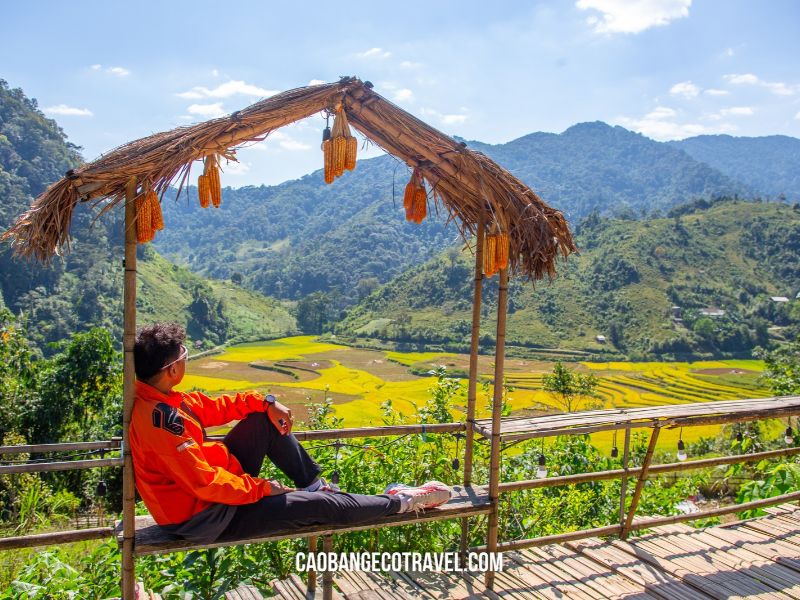
The village sits in a small valley ringed by forested ridges, with terraced fields below the houses. The lanes have been concreted for everyday use, so walking is easy in any weather. An hour covers the village; two or three hours gets you out along the field edges and up towards the forest, which is where the views open up.
Try beeswax pattern printing
This is the craft Hoai Khao is known for, and the one most visitors remember. A patterned cloth goes through four stages:
Preparation: white cloth is cleaned, beeswax is heated.
Printing: the artisan dips a bamboo tool in hot wax and draws geometric patterns freehand onto the cloth.
Indigo dyeing: the cloth is dyed repeatedly to build up the dark blue-black ground. The waxed lines resist the dye.
Removing the wax: after dyeing and drying, hot water lifts the wax and the pale pattern appears against the indigo.
Everything is done by hand, with no stencil, so an uneven stroke or wax that is slightly too hot blurs the line. Harvest runs late September through October and the women are in the fields then, so printing is not a daily activity, but most homestays will still demonstrate it if you ask when you book.
Watch the silver work
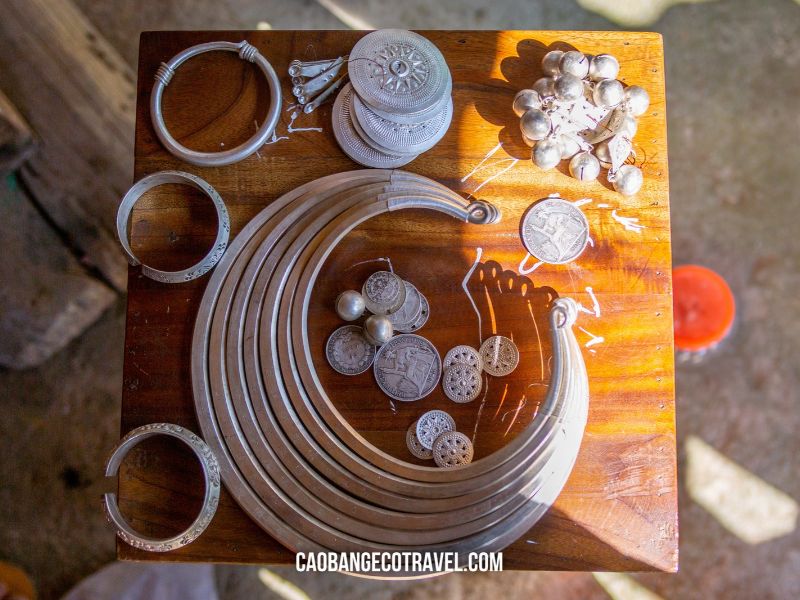
Silver carving is the other Dao Tien craft here, and unlike beeswax printing it continues year round. Smiths shape and chase the necklaces, bracelets, earrings and dress ornaments worn at weddings, festivals and rites. Several households still do it, and you can often see someone working as you walk past.
Stay the night in a homestay
Staying a night gives you more time with the family you are staying with. The seven homestays use the household's own traditional house, Nhat Nhat Homestay among them, and take around ten guests each. Households that do not host still cook, demonstrate crafts or help with guests, so the income spreads around the village. Meals lean on what the valley produces: carp and snails raised in the paddies, hill chicken, black pork, forest greens, black sticky rice, with rice or corn liquor alongside. Ask the host about an evening music exchange or a Dao herbal foot soak when you book, not on arrival.
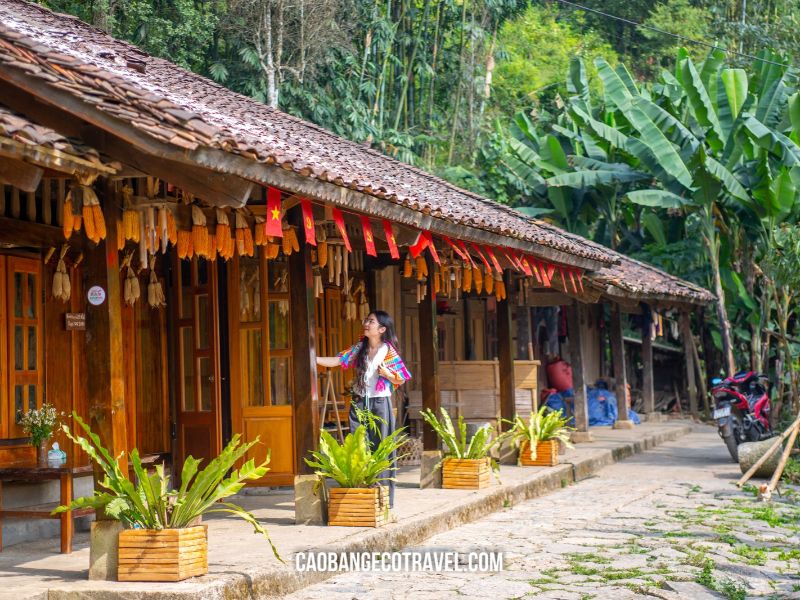
These are family homes, not guesthouses. Confirm the room type, the bathroom arrangement, whether there is hot water, which meals are included and the price before you commit. Most rooms are shared sleeping spaces rather than private doubles.
See the beeswax caves
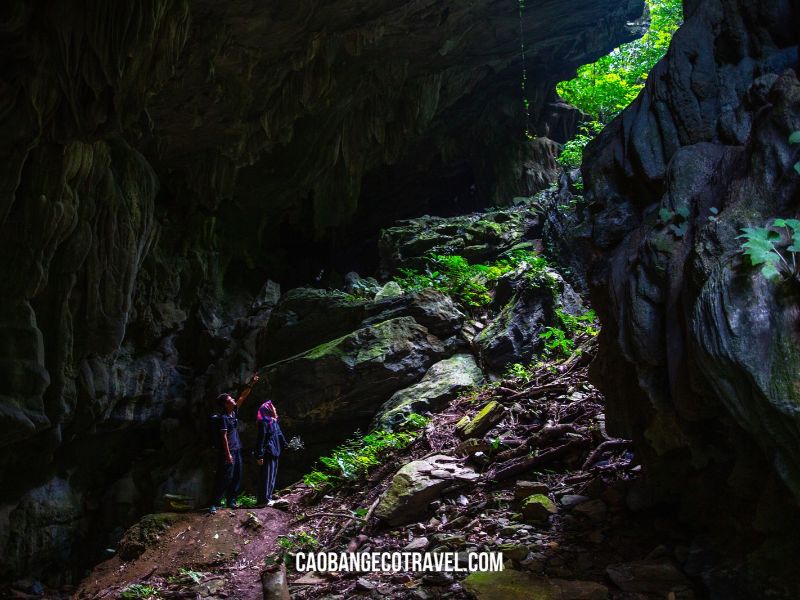
Two caves near the village hold the nests of giant honey bees (Apis dorsata), built in clusters on the rock face 15 to 20 m up. The village does not take the honey. In the seventh lunar month, once the bees have for the season, the men go up on tied bamboo poles to cut down the abandoned combs, and the wax is melted, filtered and shared out among the households. That wax is what the printing uses. The collection day is chosen carefully and preceded by an offering to the forest spirit and the bee spirit.
The nests are not there year round, and villagers are protective about who they take to the caves. If you want to see them, go with someone the village who knows both the terrain and the etiquette.
Planning your visit to Hoai Khao
The ride in crosses mountain terrain and the services in the village are run by families rather than businesses. A little preparation on weather, transport and bookings makes the difference between a good day and a wasted one.
Best time to visit
Hoai Khao works year round, and the season changes what you get rather than whether it is worth going.
| Period | Weather and landscape | What it suits |
|---|---|---|
| March to May | Warming up, everything green, occasional drizzle and morning mist | Walking the valley, Dao Tien crafts and culture |
| June to mid-September | Rainy season, forests at their greenest, heavy downpours possible | Green rice terraces, crafts, indoor time with the family |
| Late September to end of October | Ripe rice and harvest, milder, rain easing off | Photography, combining with Phja Oac - Phja Den |
| November | Mild and dry | Homestay stays, village life after the harvest |
| December to February | Cold, sharp drops at dawn and after dark, occasional frost at altitude | Homestay stays, culture; around Tet, peach and plum blossom and cloud over the tiled roofs |
March to May and September to November give you the most reliable weather. If your reason for coming is the culture and a night in a homestay, any month works. Check the forecast before you set off, since mountain rain changes the ride more than it changes the village. For the wider picture across the province, see our guide to the best time to visit Cao Bang, and our list of places to catch the golden rice season if you are timing the trip around the harvest.
How to get to Hoai Khao
Cao Bang City you ride towards Nguyen Binh and continue on to the village, about 60 km of mountain road. our office in Cao Bang City the route measures 61 km and takes around 1 hour 40 minutes of riding, before any stops. The last stretch the hamlet is narrow and steep.
| Transport | Suits | Notes |
|---|---|---|
| Self-drive motorbike | Independent riders | The road is in reasonable condition and manageable for less confident riders; just take the final climb the hamlet slowly. See our motorbike rental in Cao Bang. |
| Private car | Families and small groups | Use a vehicle under 16 seats; the lane the hamlet is tight |
| Easy Rider | Anyone not used to mountain roads | Easiest option if you want to combine Hoai Khao with other stops in the Nguyen Binh area. See our Easy Rider and Cao Bang Loop tours. |
One navigation warning that matters: Hoai Khao has been mapped in the wrong place on some digital maps, and one group of visitors ended up 20 km off course. Set your destination to Hoai Khao Cultural House rather than the village name. If it is your first time, leave in the morning so you are not riding mountain roads after dark.
Costs and booking
What you spend depends on how you get there, whether you stay the night and what you arrange with the family. The rates below are what households in the village were charging in November 2026, checked locally rather than taken booking sites, which do not list Hoai Khao:
| What | Price | Notes |
|---|---|---|
| Private room for two | Around VND 300,000 per night (about USD 12) | Limited; most houses have one or two |
| Bed in a shared room or communal stilt house | VND 120,000 to 150,000 per person per night (about USD 5 to 6) | The usual arrangement here |
| Breakfast | VND 30,000 to 50,000 per person (about USD 1 to 2) | Or included in a package agreed with the host |
| Dinner | VND 120,000 to 180,000 per person (about USD 5 to 7) | Local dishes such as black pork and paddy carp |
Contact a homestay before you arrive and agree on the room, the meals, a guide if you want one and any craft session, because none of it is set up on a walk-in basis. With seven host households taking around ten guests each, the village fills up at weekends and over Vietnamese public holidays.
If you would rather not organise it yourself, we can add Hoai Khao to a Cao Bang itinerary, arrange the homestay and put you with a rider who knows the village. Contact Cao Bang Eco Travel and tell us how many nights you have.
Local etiquette
Book ahead. Beds, meals and craft sessions all need notice so the family can prepare.
Respect the religious spaces. Do not enter worship areas, handle ritual objects or join a ceremony unless you are invited.
Ask before photographing. Especially portraits, children and the inside of houses, because this is a residential village rather than a site.
Bring cash and the right clothes. Shoes with grip, a warm layer in winter, and cash, since small services do not take digital payment.
Leave the place as you found it. No litter, no picking gardens. Handmade pieces are not always in stock, so ask in advance if you want to buy something.
Fitting Hoai Khao a Cao Bang Loop itinerary
Hoai Khao sits southwest of Cao Bang City, while the classic loop runs northeast to Ban Gioc, Nguom Ngao and the Angel Eye Mountain. The two do not overlap, which is why most riders never see it. Three ways to make it work:
Add a day to a three-day loop. Ride out to Hoai Khao, stay the night, and come back through Phja Oac the next day. This is the version that makes the trip worthwhile.
Use it as your first or last night. If you arrive in Cao Bang on an early bus or leave on a late one, Hoai Khao is a better use of the spare day than a night in the city.
Ride through on the way to Ha Giang. Travellers heading west can take in Nguyen Binh and Hoai Khao instead of backtracking to the city.
A day trip Cao Bang City is possible, but you will spend four hours on the road to see a village for two, and the crafts and the evening are the parts worth coming for.
Places to visit near Hoai Khao
Hoai Khao sits inside the Phja Oac - Phja Den area, so it combines easily with:
| Place | What it is | What to do there |
|---|---|---|
| Phja Oac - Phja Den National Park | Mixed mountain forest, cool year round | Scenic riding, forest walks |
| Phja Oac summit | 1,931 m, with a viewing platform opened in 2022 | Views and, in the right conditions, cloud hunting |
| Na Reo rammed-earth houses | Dao rammed-earth architecture on the route to Hoai Khao | A short stop for the building technique |
| Ban Phuong bamboo forest | Dense green bamboo stands | Walking and photography |
| Kolia tea plantation | Commercially run tea estate and eco-tourism site at Phia Den | Tea hills and local produce; ask about entry charges first |
Our wider guide to Nguyen Binh covers the rest of this side of the province.
Hoai Khao FAQ
How far is Hoai Khao Cao Bang City?
About 60 km Cao Bang City and about 20 km Nguyen Binh, almost entirely on mountain roads.
Is there an entrance fee for Hoai Khao village?
No. Walking around the village and taking photographs is free. You pay only for what you use: meals, a bed, a guide or a craft session, all arranged directly with the homestay.
What is the best month to visit Hoai Khao?
March to May and September to November have the most settled weather, and the harvest period late September to the end of October is when the terraces photograph best. During the harvest the women are in the fields, so beeswax printing is not a daily activity, though most homestays will still demonstrate it on request.
Can I ride to Hoai Khao myself, and how do I find it?
Yes. The road is manageable even for less confident riders as long as you take the final climb the hamlet slowly, and cars should be under 16 seats. If you are not used to mountain roads, go with an Easy Rider. Set your map destination to Hoai Khao Cultural House, not the village name, because the village has been mapped incorrectly in some apps.
Day trip or overnight?
A day trip covers the village, the architecture and a sense of Dao Tien life. An overnight stay is what gets you the meal, the crafts and the evening, and it is the version worth the 60 km each way.
Do people in Hoai Khao speak English?
Mostly no. Almost everyone in Hoai Khao is Dao Tien, so their first language is Dao and their second is Vietnamese, and few people speak English. You can still get by for the basics with Google Translate and gestures, and people are patient about it. If you want to actually talk with your hosts, about the beeswax printing, the silver work or how the village runs, come with an Easy Rider or a guide Cao Bang Eco Travel who speaks English with you and Vietnamese with the family.
Hoai Khao is a small working village rather than a destination. The crafts are still in use, the houses are still lived in, and an overnight stay is what gives you time to see that. If you want to rent a motorbike, ride with an Easy Rider or work Hoai Khao a Cao Bang itinerary that still covers the main loop, get in touch with Cao Bang Eco Travel and we will put the route together with you.

Have 0 comments, reviews about Hoai Khao: A Guide to the Dao Tien Community Village in Cao Bang
Hello. Please leave a comment, we will respond soon.