

Table of contents
- Is Ban Gioc Waterfall worth visiting?
- Entrance fee, opening hours and what the ticket actually covers
- What there is to do once youre through the gate
- The best time to visit Ban Gioc Waterfall
- How long to stay at the falls
- What to see on the road from Cao Bang City
- Is it safe to swim at Ban Gioc Waterfall?
- Border rules that apply to foreign visitors
- Why the two sides of the falls look different
- Where to get the best photographs
- Ban Gioc facts that get reported inconsistently
- Getting there from Cao Bang City
- Frequently asked questions
- Is there mobile signal and are there ATMs at the falls?
- Can I visit Ban Gioc as a day trip from Hanoi?
- Do I need to join a tour, or can I go independently?
- What is there to eat near the waterfall?
- What is the weather like at Ban Gioc Waterfall?
- Is there a hike at Ban Gioc Waterfall?
- Can I visit Ban Gioc Waterfall from Sapa?
- Is Ban Gioc suitable for elderly travellers or young children?
- Planning your Cao Bang trip

Is Ban Gioc Waterfall worth visiting?
Yes, if you arrive with your own transport and treat the falls as one stop on a two or three day trip through Cao Bang. The travellers who come away disappointed are almost always the ones who came a long way to see one thing. The waterfall takes ninety minutes to two hours. That is the whole arithmetic of the trip.
The clearest illustration comes from travelers on forums and review sites who arrived by local bus instead of their own vehicle. More than one has pointed to the same reason afterward: without a bike or car of their own, they could not reach anything else nearby, so the day collapsed into one viewpoint and a long ride home. Riders and drivers who fill the surrounding hours with the cave, the pagoda hill and the villages along the Quay Son describe an entirely different day, one rider even saying the two hour drive felt like twenty minutes.
There is also a number worth sitting with: by one published estimate, Ban Gioc draws roughly 30,000 visitors a year on the Vietnamese side, against close to a million on the Chinese side. On a weekday outside public holidays you will share a major natural landmark with very few people, which is not something you can say about Ha Giang or Sapa any more.
Skip it if you have under a week in northern Vietnam, Ha Giang is already booked, and you have no way of getting around Cao Bang except public buses. Go if you can give the province three days and either ride, drive, or hire someone who does.
Entrance fee, opening hours and what the ticket actually covers
Adult entry is 40,000 VND and children aged 6 to under 16 pay 20,000 VND, under the fee schedule the Ban Gioc Waterfall Management Board put in force on 4 July 2026 (Notice No. 138/TB-BQLKDLTBG, dated 2 July 2026). Older guides still quote 45,000 or 50,000 VND. Those figures are out of date.
| Item | Price (VND) | Notes |
|---|---|---|
| Adult entry | 40,000 | Per person, per entry |
| Child entry, age 6 to under 16 | 20,000 | Under 6 free |
| Visitors entering from the Chinese side | 70,000 | Applies to the cross-border landscape area only |
| Electric buggy | ~25,000 | Car park to the entrance gate, roughly 1 km |
| Bamboo raft to the base of the falls | 50,000 | 10 to 15 minutes, life jackets available, you will get wet |
| Horse ride along the path | ~50,000 | Entrance area toward the foot of the falls |
| Tay or Nung costume rental for photos | 100,000 to 150,000 | Stalls along the walkway |
| Motorbike parking | ~10,000 | Car parking is free |
What arrival actually looks like
Vehicles stop in the residential area roughly a kilometre short of the falls. From there you either walk or take the electric buggy to the gate, then follow a paved path that runs between rice fields and over small bridges to an open grass bank at the foot of the cascades. The path itself is flat, short and paved; the grass and rock right at the water's edge are the only uneven, spray-slicked part of the route.
The site opens daily from 07:00 to 18:00. Bring small notes: card payment is not reliable here and the nearest ATM is back toward Trung Khanh.
The Ban Gioc Waterfall Festival itself is worth knowing about even outside the fee exemption. Trung Khanh district holds it annually in October, typically over two days, built around cultural performances and local trade and tourism promotion. Exact dates shift from year to year and are usually only confirmed a few weeks ahead. As of August 2026, the 2026 dates had not yet been published, so check closer to your travel dates rather than planning around them.
What there is to do once you're through the gate
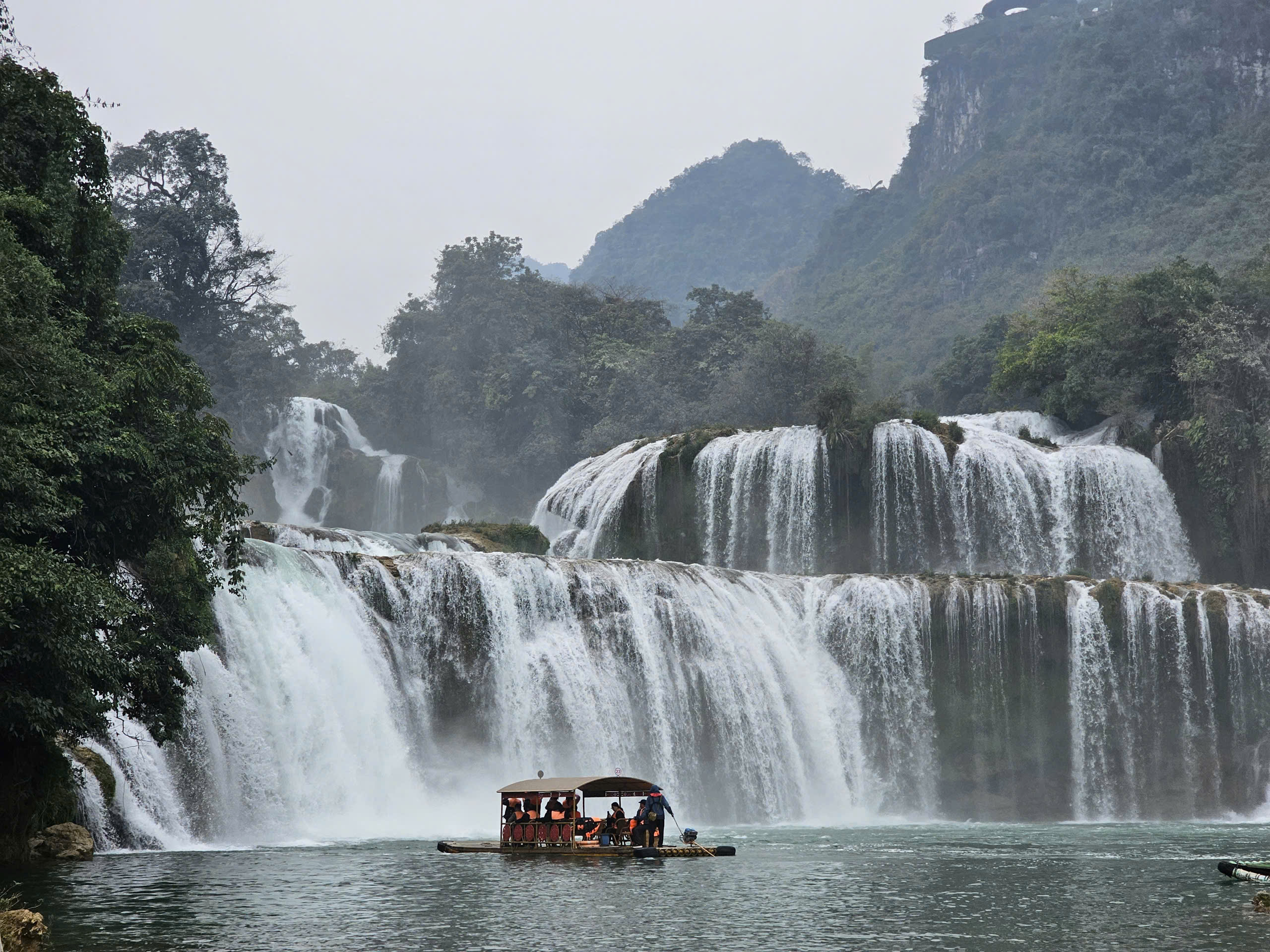
Past the ticket gate, the options are the raft, a walk along the bank, a horse to the water's edge, costume photos, and simply sitting down with food you brought. None of it needs booking ahead, and most of it costs 50,000 VND or less.
The raft is the one worth doing. It poles out from the Vietnamese bank into water that runs jade to turquoise depending on the season, close enough to the main cascade that the spray reaches you before the boat turns back. Boats from both countries work the same stretch of river, so you will likely drift past a raft from the Chinese side going the same route, and a wave gets one back almost every time.
The grass bank at the foot of the falls is open with patches of shade, and it works well as a picnic spot rather than a place to rush through. If you plan to bring food, buy it in Cao Bang City or Trung Khanh before you set off, since the stalls at the gate sell snacks rather than meal-sized portions.
Horses wait near the entrance for the short stretch toward the water, more useful if walking is a struggle than if you want speed, since the distance is short either way. Costume rental stalls line the same walkway, mostly Tay and Nung dress, and what people are really paying for is the backdrop of limestone and falling water rather than the costume itself.
The best time to visit Ban Gioc Waterfall
September and October give the best combination: the river is still high from the summer rains, the water has cleared, and the rice terraces around Trung Khanh are turning gold. Every other month involves a trade-off between water volume and water colour.
| Period | What the falls look like | Worth knowing |
|---|---|---|
| June to August | Highest volume, loud and wide | Runoff turns the water brown; storms can close mountain roads |
| September to October | Strong flow, clearer water | The window most photographers aim for; harvest colour in the valley |
| November to January | Gentler, turquoise and clear | Cold mornings, thin crowds on weekdays |
| February to May | Lowest flow, sometimes split into separate ribbons | Clear emerald water and white ban blossom on the drive north in March |
Dry season visitors often expect to be disappointed and are not. A Reddit traveller asking about a mid-March trip was told by a local that the falls trade volume for colour in those months, turning clear turquoise instead of the muddy brown of the rainy season. That matches what we see: March visitors take better photographs, June visitors get better sound.
You will find other guides naming a different best month, and they are not wrong so much as optimising for something else. Guides that pick June to September are ranking sheer water volume. Guides that pick September alone are ranking the harvest. Guides that pick the dry months are ranking water colour and comfortable walking weather. Decide which of those three matters most to you and the month picks itself. This section is about the falls specifically; if you are weighing timing for the wider province, including road conditions and the rest of the loop, our best time to visit Cao Bang guide covers that ground.
The rice fields matter as much as the water for how the valley looks. The paddies right at the base of the falls, farmed by the local border guard post, stay green through the growing months and turn gold from around mid-September into early October, the same short window that also gives the clearest water. Dawn, from roughly 05:00, and late afternoon from around 15:00 are when the gold light on the fields is strongest.
One detail worth verifying on the day: several visitors report that water is released from the dam upstream in the late morning, lifting the flow for a few hours in the drier months. Vietnam's national tourism board describes a daily release late in the dry season, roughly between 10:30 and 13:00. Ask at the ticket office when you arrive rather than planning your whole day around it.

How long to stay at the falls
Ninety minutes to two hours covers the walk, the viewpoints and a raft ride, and three hours is generous. Tripadvisor lists the site as a one to two hour visit, and that is honest. The complaint that there is nothing to do once you have seen the water is fair when the waterfall is the only line in your plan.
Arriving before 09:00 changes the visit more than anything else. Domestic coach groups build through the middle of the day, and the far bank fills with Chinese tour groups at the same time. Early morning also gives softer light on the cascades and an empty foreground.

What to see on the road from Cao Bang City
The 90 km between Cao Bang City and the falls hold more than the falls themselves do, and building the day around these stops is what separates travellers who rate this trip from travellers who regret it. Everything below sits on or just off the direct route, so none of it costs you a detour.
- Ma Phuc Pass, about 25 km out. The first real viewpoint of the day, a switchback climb between limestone teeth with somewhere to stop at the top.
- Phuc Sen blacksmith village, roughly 30 km east of the city just past the pass. Tay families here forge knives by hand, and local accounts trace the craft back to weapon workshops of the Mac dynasty in the sixteenth century. The better forges are past the village centre, perched on the roadside above the valley, not among the shops.
- Bamboo water wheels on the Quay Son, visible in stretches after Quang Uyen. River-powered, hand-built, and used to lift water up into the irrigation channels. They are steadily disappearing, because every serious storm destroys some and not all get rebuilt.
- Nguom Ngao Cave, about 3 km from the falls. Roughly 2,144 metres of chambers with three entrances, opened to visitors in 1996 and lit along a paved route. Entry around 45,000 VND, with a deeper guided route available for more. Allow 45 to 60 minutes. The name means Tiger Cave in Tay.
- Khuoi Ky stone village, a few minutes from the cave. Fourteen Tay stilt houses built from stone rather than the usual timber, facing the Khuoi Ky stream, with homestays for anyone who wants to sleep near the falls and start early.
- Phat Tich Truc Lam Ban Gioc Pagoda, around 500 m from the entrance and up the hillside. Inaugurated in 2014 as the first pagoda built on Vietnam's northern border, with a 1.5 tonne bronze bell and the best elevated view of the valley available from Vietnamese ground. The climb is steep. Go at sunset.
Further out, Phong Nam valley and Nui Thung, the karst peak with a hole through it, are both under an hour away and both quieter than anything at the waterfall. If you want a fuller overview of where to sleep along this stretch, our guide to where to stay in Cao Bang breaks down the options by area rather than just by name.
If you stay overnight nearby, the area is walkable. It is roughly 3 km on foot from the cluster of homestays and guesthouses to the falls, about 45 minutes at a steady pace from Khuoi Ky, and around 15 minutes from Khuoi Ky to Nguom Ngao Cave. The walk runs through rice fields and past working farms, which is a better introduction to the valley than arriving by vehicle. Start early: the middle of the day gets hot here from April onward, and travellers who underestimate that end up abandoning the rest of their plan.
Is it safe to swim at Ban Gioc Waterfall?
No. Swimming is prohibited and there are signs to that effect posted around the site. Two separate reasons sit behind the rule: the currents and submerged rock at the base of the cascades, and the fact that the river is an international boundary, so drifting across it is a border matter rather than a swimming matter.
Older travel reports from before the site was formally managed do describe people swimming here. That is no longer the situation on the ground. The rafts are the sanctioned way to get close, and they carry life jackets colour-coded by country.
One safety point worth knowing before you step on: wearing the life jacket is not always enforced. Ask for one and put it on. The rafts are shallow poled craft, they get close enough to the falls that the deck is wet, and the water under you is deep and moving.
Border rules that apply to foreign visitors
Carry your original passport, stay on the Vietnamese bank, and do not expect to cross to the Chinese side. Ban Gioc is an active frontier, and the guards on both banks are watching the water, not the tourists' itineraries.
The cross-border zone confuses a lot of people, so it is worth being precise. The China-Vietnam Detian-Ban Gioc Cross-Border Tourism Cooperation Zone began trial operation in September 2023 and entered official operation on 15 October 2024, letting visitors walk from one country's side of the falls to the other. It runs on pre-booked groups of no more than 20 people, fixed routes and time limits, and a daily cap on visitor numbers. Access is restricted to holders of Vietnamese and Chinese passports and exit-entry permits. As things stand, a European, American or Australian passport does not get you across, however you book it.
Three more rules that catch visitors out: do not photograph toward Chinese territory where signs prohibit it, do not buy goods from small boats paddling over from the far bank, and do not cross the marked river boundary even briefly. Arrangements at border sites change, so confirm the current position with your accommodation before you travel.
Why the two sides of the falls look different
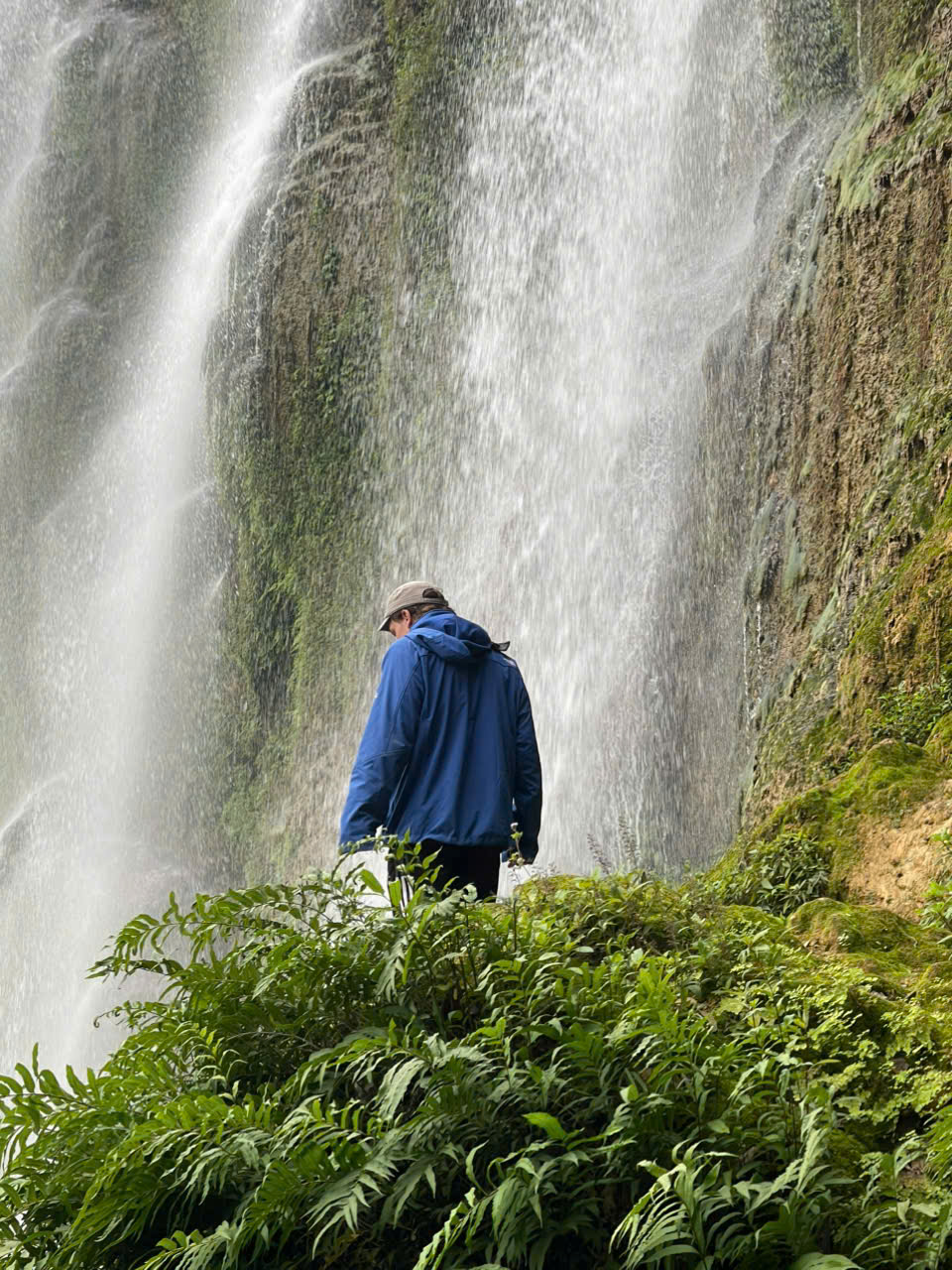
The Chinese side has the viewing platforms, the walkways up the hillside and the visitor numbers. The Vietnamese side has the grass bank at water level and almost nobody on it. That difference in infrastructure, not in beauty, is what people are describing when they repeat the line that the Chinese side is better.
From Vietnam you stand at the base, level with the water, with the full three-tier cascade in front of you and the secondary falls off to one side. Height has to come from the pagoda hill, since there is no purpose-built platform on the Vietnamese bank. Rafts from both countries share the same stretch of river and pass within waving distance of each other, which means the head-on view of the falls is available to everyone regardless of which bank they started from.
Vietnam Coracle, who has covered this region for years, dismisses the Chinese-side-is-better claim outright and notes that visitors on the Chinese side say exactly the same thing in reverse.
Where to get the best photographs
The hillside at Phat Tich Truc Lam Pagoda gives the only wide elevated view from Vietnamese soil, and early morning gives the only reliably empty foreground. There is no purpose-built viewing platform on the Vietnamese bank, unlike the Chinese side, so height has to come from the pagoda path.
- Riverbank, right of the entrance: the classic three-tier composition, best between 08:00 and 09:30 before the light goes flat and the crowds arrive.
- From a raft: close, dramatic, and wet. Bring a cloth and keep the lens pointed away from the spray until the last moment.
- Pagoda hillside: the full valley including the rice fields, and the best position at sunset.
- Drones: do not plan on flying. This is a controlled border area and drone use near the falls is not permitted.
On technique: a wide-angle lens gets the full three-tier cascade in one frame from the riverbank, where a standard lens forces you to choose between height and width. A slower shutter speed, if your camera allows manual control, turns the falling water into the soft, silky blur you see in the better photos of Ban Gioc, though you will need a steady hand or a small tripod for anything under about 1/15 of a second.

Ban Gioc facts that get reported inconsistently
Ban Gioc is the most famous waterfall in Vietnam and the largest in Southeast Asia, but the measurements you will find online disagree with each other, and it helps to know why.
- Width: 208 m or 300 m. Vietnamese state sources give 208 m for the main cascade. Many international guides give around 300 m, counting the main and secondary falls together as one system.
- Height: 30 m or 70 m. The 30 m figure describes the tallest single drop. The 70 m figure is the total descent across all three limestone tiers.
- ''Fourth largest in the world.'' This is a ranking among waterfalls that sit on an international border, after Iguazu, Victoria and Niagara. It is not a global ranking of waterfalls overall.
- Two names, one waterfall. Ban Gioc in Vietnam, Detian in China. The site covers around 400 hectares split between Cao Bang province and Guangxi.
- Protected status. The falls sit inside the Non Nuoc Cao Bang UNESCO Global Geopark.
One piece of context that most guides leave out: this stretch of border was fought over within living memory. In February 1979 Chinese forces crossed into several points along Vietnam's northern frontier, Cao Bang among them, and thousands died on both sides before the withdrawal. Along the border road just past the falls there are memorial shrines to local Vietnamese killed in that conflict. The atmosphere at Ban Gioc today is relaxed and the official presence is light, which is worth appreciating rather than assuming.
Administrative note for anyone cross-checking addresses: Vietnam reorganised its local government in 2025 and the district level was removed, so the falls are now officially in Dam Thuy commune, Cao Bang province. Older sources say Trung Khanh district. Same place.
Getting there from Cao Bang City
It is about 90 km and two hours each way, and the choice between bus and your own wheels decides how good the day is. The route runs east on QL3 over the Ma Phuc Pass to Quang Uyen, then north on DT206 through Trung Khanh to the falls.
- Local bus. Cheap, frequent through the day, and it drops you across from the entrance. The catch is that it cannot stop at the pass, the forges or the water wheels, which is most of what makes the drive worth doing.
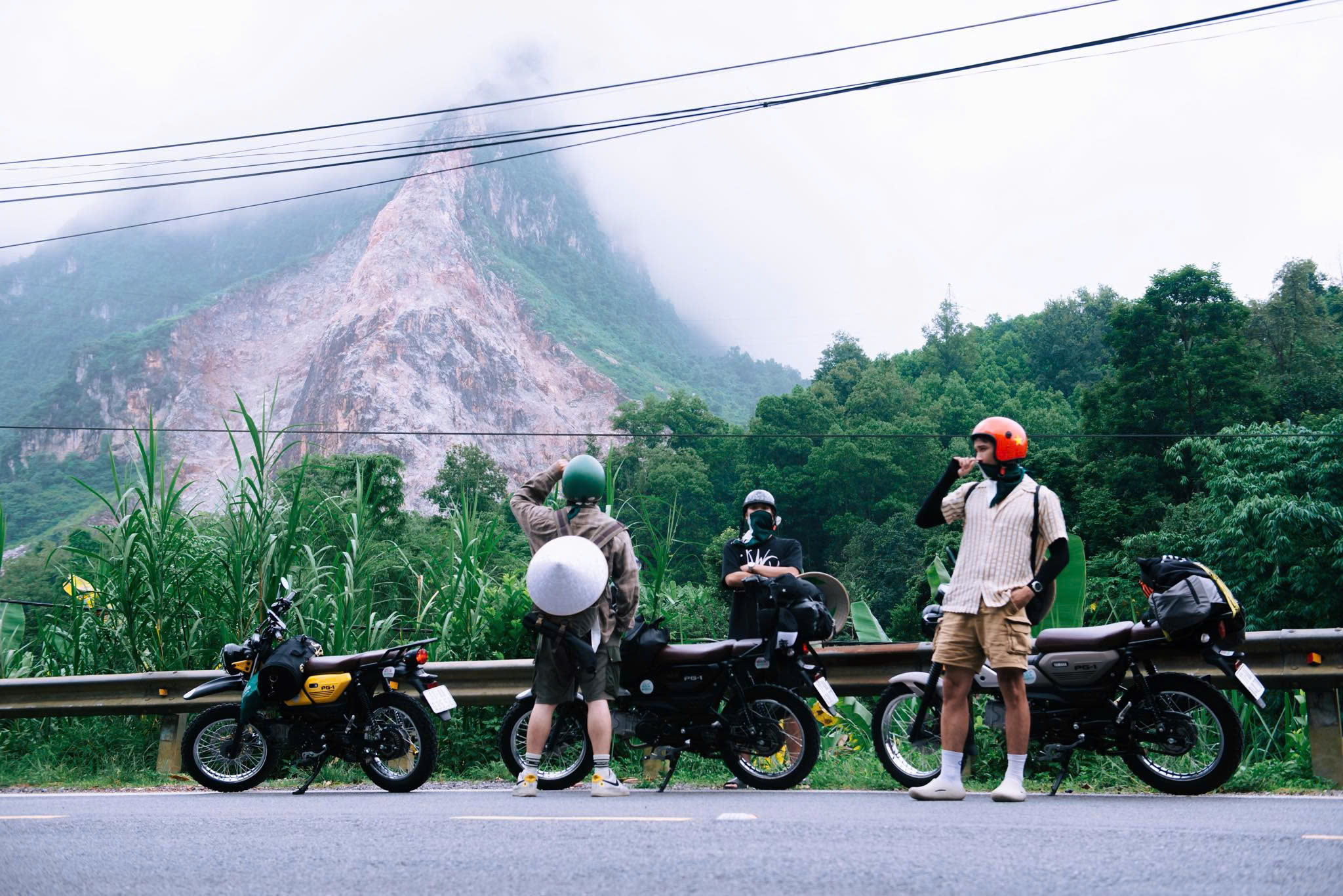
- Rented motorbike. The version we would recommend if you hold the right licence. Around 200,000 VND per day is the going rate for a motorbike rental in Cao Bang City, and the road is sealed and in good condition nearly all the way. One thing to watch for: DT206 carries a steady stream of trucks hauling border trade, and overtaking on the hairpin sections is common, so keep to your side on blind corners rather than assuming the road is empty because it looks quiet.
- Car with driver. The sensible option for families, older travellers and anyone who does not ride. Expect somewhere in the region of 2 to 2.5 million VND for a full day, depending on vehicle and route.
- Easy rider. You ride pillion, a local guide handles the road. No licence needed, and you still get the stops.
If you have your own wheels, the return trip does not have to retrace the same road. From the falls, DT206 continues east before turning south and becoming DT207, rejoining QL3 back at Quang Uyen. It runs closer to the border and the surface is rougher than the way in, so it suits confident riders more than a first attempt at Vietnamese mountain roads, but it turns the day into a loop rather than an out-and-back.
Rough cost for one person doing the falls as a day trip from Cao Bang City on a rented bike, in VND:
| Item | Cost |
|---|---|
| Motorbike rental, one day | ~200,000 |
| Fuel, 180 km round trip | ~100,000 |
| Waterfall entry | 40,000 |
| Motorbike parking | ~10,000 |
| Raft ride | 50,000 |
| Nguom Ngao Cave | ~45,000 |
| Lunch en route | 50,000 to 100,000 |
| Total | roughly 500,000 to 550,000 |
Coming direct from the capital instead? The full breakdown of buses, limousines, private cars and riding times is in our Hanoi to Ban Gioc Waterfall guide.
Frequently asked questions
Is there mobile signal and are there ATMs at the falls?
Vietnamese networks work at the site, though phones often latch onto a Chinese carrier because the border is metres away, which can trigger roaming charges. Turn off data roaming before you arrive. There is no ATM at the falls, so withdraw cash in Cao Bang City or Trung Khanh.
Can I visit Ban Gioc as a day trip from Hanoi?
Physically yes, sensibly no. Hanoi to Cao Bang is 7 to 8 hours each way, so a same-day return means roughly 15 hours in a vehicle for 2 hours at the falls. Two days is the realistic minimum, three days is the version people enjoy.
Do I need to join a tour, or can I go independently?
Independent travel works well here. Public buses run from Cao Bang City, tickets are bought at the gate, and no permit is required for the waterfall itself. A guide or driver adds most value on the surrounding route, where villages and viewpoints are hard to find without local knowledge.
What is there to eat near the waterfall?
Stalls at the entrance sell drinks, snacks and roasted Trung Khanh chestnuts, which are a genuine local speciality rather than a tourist prop. For a real meal, the homestays and guesthouses around Khuoi Ky cook to order, so stop and place your lunch order on the way to the falls and eat on the way back. Dishes worth asking for around Trung Khanh include grilled river fish stuffed with herbs, roast duck, smoked dried beef or buffalo, and banh khao, a sticky rice cake with sesame, peanut and pork fat that Tay and Nung families make for Tet. Back in Cao Bang City, the two provincial dishes to try are banh cuon served in bone broth and pho chua.
What is the weather like at Ban Gioc Waterfall?
Cao Bang sits high enough that it runs noticeably cooler than Hanoi in both directions. Summer, from around May to August, averages 25 to 28°C with the year's heaviest rain concentrated in June and July, sometimes with sudden storms. Winter, December through February, averages 14 to 18°C and can be genuinely cold in the mornings, with frost and occasional light snow at higher elevations around Trung Khanh, which sits higher and runs cooler than Cao Bang City itself. Pack a warm layer for a winter visit and a rain jacket for a summer one; this is a different climate question from when the falls look best, since a January morning can be beautifully clear and cold at the same time.
Is there a hike at Ban Gioc Waterfall?
Not really, not any more. The closest thing to a formal trail up through the trees to the pools above the falls has been blocked off by a guard post for several years. What remains is the steep but short climb to Phat Tich Truc Lam Pagoda, and the roughly 3 km walk between the falls and the homestay cluster near Khuoi Ky, which runs through rice fields and working farmland rather than forest. If proper trekking is what you are after, that belongs elsewhere in Cao Bang province, not at the falls themselves.
Can I visit Ban Gioc Waterfall from Sapa?
Not as a side trip, no. The two sit roughly 480 km apart with no direct road between them, so getting from one to the other means routing back through Hanoi, a trip of 7 to 8 hours of driving at minimum and closer to 16 to 17 hours door to door if you rely on buses and transfers. Some longer guided tours link the two through Ha Giang instead, but that is a multi-day loop, not a detour. Treat Sapa and Ban Gioc as two separate legs of a Vietnam itinerary rather than places to combine casually.
Is Ban Gioc suitable for elderly travellers or young children?
Yes, with one caveat. The route from the car park to the viewing area at the foot of the falls is flat and paved, an electric buggy covers the first kilometre, and the raft ride is calm. Travellers in their seventies do this walk regularly and manage it without difficulty. The caveat is the grass and rock at the water's edge, which is uneven and slick with spray, and the pagoda climb, which is steep and should be treated as optional. Grippy shoes matter more than fitness here.

Planning your Cao Bang trip
Ban Gioc rewards travellers who build a route around it rather than a detour to it. We are based in Cao Bang City and run the surrounding roads year round: motorbike rentals for independent riders, easy rider and guided loop tours for anyone who would rather not ride, private cars with drivers, camping, and homestay accommodation between the waterfall and the city. If Cao Bang City itself is also on your list, our guide to what to do in Cao Bang City covers that half of the trip.
For a guided option that already builds in the stops this article covers, our 2 day, 1 night tour pairs Ban Gioc with Nguom Ngao Cave and Angel Eye Mountain, and the 3 day, 2 night version adds Khuoi Ky and Thang Hen Lake. If neither fits your dates exactly, tell us how many days you have and we will tell you honestly whether Ban Gioc fits.
• Website: Caobangecotravel.com
• Email: Caobangecotravel@gmail.com
• Hotline & Whatsapp (7am-11pm)


Have 0 comments, reviews about Ban Gioc Waterfall: The Largest Waterfall in Southeast Asia
Hello. Please leave a comment, we will respond soon.